
AI side hustles 2026 fall into two groups. In one group, people use AI to do real work faster for a specific customer. In the other, people copy the same cheap output as everyone else and watch prices fall. Which group you land in depends more on your skills than on the tools you pay for.
The data points the same way. Upwork’s Future Workforce Index 2026 found that freelancers doing AI work on its marketplace earn 34% more per hour than those who don’t. But contract starts for generative AI and creative production grew 90% while pay per contract fell 13%. Freelancers doing more complex AI-augmented work saw earnings rise 45% year over year.

Side income is also modest overall. Bankrate’s 2025 survey put the median US side hustle at $200 a month, down from $250 the year before. That figure covers all side hustles, not only AI ones. It is a good reminder to keep expectations realistic.
This guide covers 12 AI side hustles 2026 readers in the US and around the world can realistically start. For each one you get the cost, the skills, the main risk, who it suits and a first step you can take this week. You will also see which popular ideas are getting riskier and how to avoid scams. Nothing here is a promise of income. Results depend on your skills, location, time, pricing and how well you find customers.
Table of Contents
What Is an AI Side Hustle?
An AI side hustle is extra income where AI tools play a real part in how you create or deliver a product or service. You still choose the customer, check the output and take responsibility for the result.
It is not “press a button and collect money.” AI can draft, summarize, sort and generate options quickly. It also makes up facts, repeats generic phrasing and misses context, so someone has to check every output before a customer sees it. That someone is you, and it is the part customers pay for.
How AI Side Hustles 2026 Differ From Earlier Years
A couple of years ago, knowing how to use ChatGPT was enough to stand out. Basic AI use is now normal, and the market has started to sort people by skill.
In the Upwork data, the gains went to complex, judgment-heavy work, while lower-complexity production work lost ground. In plain terms, customers pay more for someone who understands their problem than for someone who can write a prompt.
That is why the list below leans toward services built on a real skill. If an idea only works because you know a tool, anyone can copy it next week. If it works because you understand a customer’s problem, copying it is much harder.
Quick Comparison of AI Side Hustles 2026
Costs and timelines are rough estimates, not measured data. Your results will vary.
| Side hustle | Startup cost | Skill needed | Typical time to first customer | Main risk |
| AI-assisted writing and editing | Low | Writing | Weeks | Generic output, invented facts |
| Social media management | Low | Marketing basics | Weeks | Client churn |
| Custom chatbots for small businesses | Low to medium | Tool setup | Weeks to months | Wrong answers, upkeep |
| Workflow automation setup | Low to medium | Process thinking | Weeks to months | Fragile connections |
| AI-assisted SEO and content audits | Low | SEO knowledge | Weeks | Needs real expertise |
| AI virtual assistant services | Low | Organization | Weeks | Low pay if generic |
| Design and visual content | Low | Design sense | Weeks | Copyright, crowded market |
| Video editing and repurposing | Low | Editing | Weeks | Time-heavy |
| Digital products and templates | Low | Niche knowledge | Months | Crowded marketplaces |
| Niche newsletters | Low | Writing, curation | Months | Slow audience growth |
| AI training and data tasks | None | Varies | Varies | Unpredictable work |
| Workshops for a profession | Low | Expertise | Months | Needs credibility |
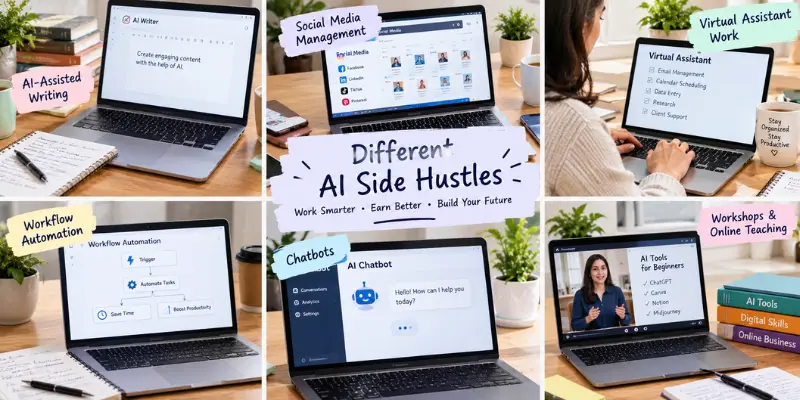
12 AI Side Hustles 2026 Worth Considering
Each idea includes a first step. Start with the one that matches a skill you already have.
1. AI-Assisted Writing and Editing
Businesses need blog posts, emails, captions, product descriptions and web copy. You can use AI to draft faster, then edit for accuracy, voice and strategy. The service you sell is the finished, checked piece, not the first draft.
Some clients ban AI use, so ask before you start and be open about your process if they ask. Always check names, dates and numbers yourself. For more on this path, see our list of freelance writing side hustles.
First step: pick one niche, such as software or home services, and write two fact-checked sample pieces. Best for: clear writers who take feedback. Watch out for: low-paying content mills and unlimited revisions.
2. Social Media Management
Small businesses often let their social accounts go quiet because nobody has time. You can plan content, draft captions with AI, schedule posts and report on what worked.
The hard part is not the posting. It is finding and keeping clients. Start with one or two local businesses and a simple monthly plan. The work overlaps with the tasks in our virtual assistant side hustle guide.
First step: draft a one-month content plan for a business you know and offer it as a free sample. Best for: people who already follow what works on social platforms. Watch out for: clients expecting follower growth you cannot control.
3. Custom Chatbots for Small Businesses
Many small shops answer the same questions all day: shipping times, opening hours, product details. A chatbot trained on that shop’s own information can handle the routine ones. No-code tools make this possible without programming.
Test everything before handing it over. A bot can give wrong answers or drift off topic, so limit it to approved information and plan regular checks. Industries such as law and healthcare raise privacy concerns, so start with simple retail or service businesses.

First step: build a demo bot from one friendly business’s FAQ, with permission, and test it with 20 real questions. Best for: people who explain technology simply. Watch out for: wrong answers and customers who expect free maintenance.
4. Workflow Automation Setup
Automation connects the tools a business already uses so routine tasks run on their own: following up with leads, sorting forms, sending reminders, summarizing weekly reports. You pick one repeated task, build it for one business and show a clear before-and-after.
This tends to pay better than basic content work because the customer sees saved hours. It also needs more patience and testing. Connections break when a tool changes, so a support arrangement is part of the job.
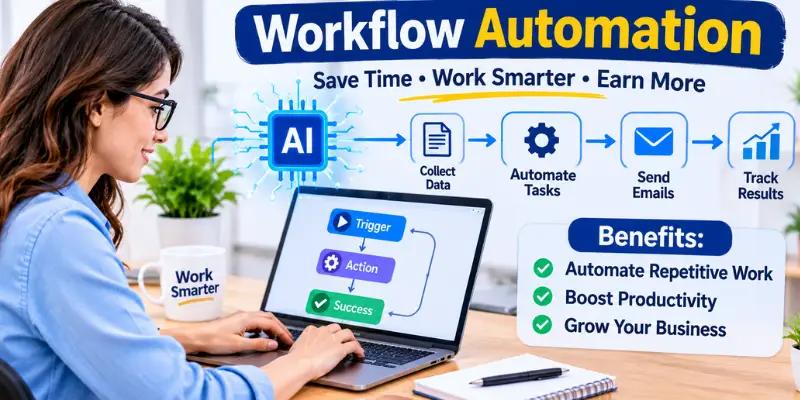
First step: automate one weekly task of your own, then use it as your case study. Best for: organized people who like solving process problems. Watch out for: overpromising and unclear scope.
5. AI-Assisted SEO and Content Audits
If you understand search intent, keywords and internal linking, AI can speed up the research. You might audit a blog, find topics competitors cover that a client misses, and refresh old posts.
You need real SEO knowledge here. AI can summarize pages quickly, but it cannot tell you whether the advice is right. Offer a small, fixed-price audit first rather than a long contract. If you run a blog yourself, our blogging side hustle guide shows the basics.
First step: audit one small site and list five fixes with the reason for each. Best for: marketers and bloggers with search experience. Watch out for: generic reports any tool could produce.
6. AI Virtual Assistant Services
Virtual assistants handle inboxes, scheduling, data entry and reports. AI can summarize emails, draft replies and tidy notes, which lets one assistant handle more work without lowering quality.
Pick a narrow client type, such as coaches or online store owners, and one repeated process you can set up well. A niche beats a general offer almost every time.
First step: write a one-page service menu for a single client type. Best for: detail-oriented people who like organizing. Watch out for: sharing sensitive client data with tools without permission.
7. Design and Visual Content Services
You can offer social graphics, mockups, mood boards and ad variations using AI image tools. The value is in your judgment: choosing the right design for the client and fixing what the AI gets wrong.
Be careful with ownership. The US Copyright Office has said that prompts alone do not give enough human control to make someone the author of an AI output. That means you may not be able to protect purely AI-generated images the way you protect your own work. Read each platform’s terms and tell clients how the work was made.

First step: make a five-piece sample set in one brand style and note what you edited by hand. Best for: people with a design eye. Watch out for: copyright gaps, crowded marketplaces and copying living artists’ styles.
8. Video Editing and Repurposing
Creators and small brands need long videos cut into short clips with captions and a clear hook. AI tools can produce a first cut and captions, and you polish the result by hand.
Rates vary widely, so price per video instead of per hour. Build a few free samples before you pitch.
First step: cut one long video you have permission to use into three short clips. Best for: people who enjoy editing and pacing. Watch out for: heavy files, tight deadlines and late changes of mind.
9. Digital Products and Templates
Templates, checklists, planners and niche tool setups are made once and sold many times. The ones that sell solve one specific problem for a specific group, such as a content calendar for solo accountants. Generic prompt packs are everywhere and sell poorly.
Many shops earn nothing for the first months. See how this model works in our digital planner side hustle article, and read how to make passive income before you count on it. If you are a teacher, our side hustles for teachers page has related ideas. For more product-style options, see online passive income.
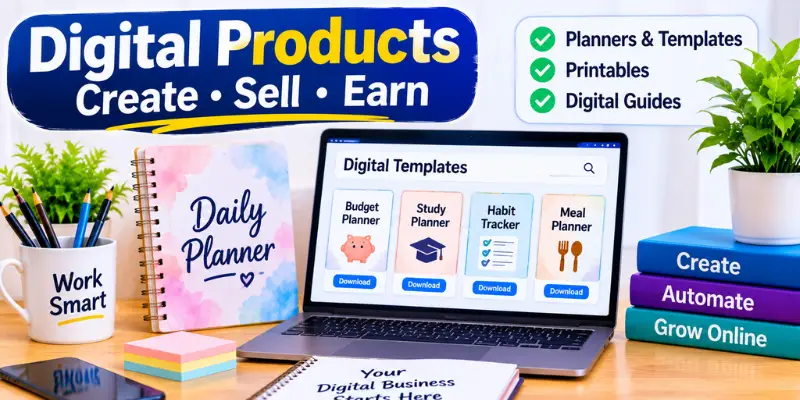
First step: ask five people in your niche what annoys them, then build a template for the most repeated answer. Best for: people with deep knowledge of a small niche. Watch out for: marketplace fees and low prices.
10. Niche Newsletters and Summaries
A short, trusted newsletter in a narrow field can work if you bring judgment. AI helps with research and first drafts, but readers pay for your selection and commentary, not for raw summaries.
Growth is slow. Plan for months of free issues before you ask anyone to pay, and check facts closely because one error damages trust fast.
First step: write three issues before you announce anything. Best for: writers with real expertise in a niche. Watch out for: slow audience growth and burnout.
11. AI Training and Data Tasks
Some platforms pay people to rate or write answers used to improve AI systems. It is gig work: you are paid per task, you do not set the price and the supply can change without notice. Pay, rules and country eligibility vary by platform, so read the terms before you sign up.
Never pay a fee to join a platform that offers this kind of work. Real platforms pay you.
First step: read the platform’s pay and eligibility terms and confirm it does not charge to join. Best for: small, flexible extra income and a view of how AI output fails. Watch out for: waiting lists, country limits and fake sites that charge sign-up fees.
12. AI Workshops for a Profession
If you work in a field, you can teach colleagues how to use AI safely in it. Think “AI for real estate agents” or “AI for school administrators,” with examples from your own industry.
This tends to pay best among the services here, but it needs credibility. Start with a free session for a small group, collect feedback and build a short outline you can repeat. If you prefer one-to-one teaching, our tutoring side hustle guide is a good companion.
First step: write a 45-minute outline built around three real tasks from your own job. Best for: experienced professionals. Watch out for: advice that goes out of date quickly.
Which AI Side Hustles 2026 Pay the Most?
The best-paid options usually combine AI with expert knowledge: workflow automation, professional workshops and SEO or marketing audits. The lowest-paid are generic content tasks anyone can produce. That matches the Upwork pattern above, where complex work gained value and simple production work got cheaper.
There is a tradeoff in speed. Some entry-level tasks pay quickly. Service work often takes weeks to land a first client, and products and content take months.
Price by result, not by hours. If AI makes you faster, an hourly rate makes you look cheaper. A fixed price for a clear outcome, such as a month of edited posts or a working chatbot, fits better. Because most of these services are active income, you earn when you do the work, so your time still sets a ceiling.
AI Side Hustles 2026 That Are Getting Riskier
Some popular ideas look easy but run into platform rules or falling prices.
Fully automated YouTube channels.
YouTube’s “inauthentic content” policy covers mass-produced or repetitive content, and YouTube has described it as a clarification of a long-standing rule. AI-assisted channels can still qualify when the content is original and adds value. Ad revenue currently needs 1,000 subscribers plus 4,000 qualified watch hours or 10 million qualified Shorts views. From February 1, 2027, new applicants will need 8,000 watch hours or 20 million Shorts views.
AI content farms.
Google’s scaled content abuse policy targets many pages created mainly to manipulate rankings instead of helping people, including pages made with generative AI that add no value. Fast, cheap pages are exactly what this rule aims at.
AI-generated books.
Amazon KDP requires authors to tell it when content is AI-generated, while AI-assisted editing does not need disclosure. Disclose honestly and follow the content guidelines.
Courses about making money with AI.
The market is crowded with recycled advice. A course only works if the person selling it built and tested what they teach.
Prompting as your only skill.
Prompting alone is easy to copy. Upwork’s data suggests the premium goes to people who combine AI with judgment in a specific field.
Pros and Cons of AI Side Hustles
Pros
- Low startup costs, since many tools have free tiers.
- You can deliver faster and take on more work.
- Easy to test an idea before committing.
- The skills you build transfer to other work.
Cons
- Competition is high because the barrier to entry is low.
- AI output needs checking for errors and made-up facts.
- Platform and tool rules change often.
- Simple AI tasks are getting cheaper.
Who Should Try AI Side Hustles 2026 (and Who Should Skip Them)
These suit people who already have a skill, such as writing, design, marketing, teaching or organizing, and want to deliver it faster. Students can test ideas without much money, so see our side hustles for students list. Engineers have extra options in our side hustles for engineers article, and quieter personalities may prefer side hustles for introverts. US readers can also browse our side hustle in the USA guide.
Skip them if you need fast, fixed income or want to avoid learning a skill. Tools alone will not carry you, and the quick-money versions are where most scams and rule changes show up.
Using AI Side Hustles 2026 Outside the US
Most of these ideas work anywhere you have internet access and clients. A few things change by country:
- Data source: the Bankrate figure is a US survey, and Upwork’s survey covered US workers, though its marketplace data is broader. Treat both as signals, not local pay guides.
- Payments: check which platforms pay out in your country and what fees and currency conversion cost you.
- Platform rules: AI training sites and marketplaces sometimes limit which countries they accept. Read eligibility terms first.
- Tax: every country treats side income differently. Check your own tax authority before you start, and keep records from day one.
- Language and market: local-language services, such as writing or support in a language few AI-skilled freelancers offer, can face less competition. That is a reasonable hypothesis, not a measured fact.
- Clients: written agreements matter more when your client lives in another country. Agree on scope, price and payment terms first.
How to Spot AI Side Hustle Scams
The AI label is now used to sell almost anything, and scams built around AI side hustles 2026 buyers search for follow familiar patterns. The FTC’s Operation AI Comply went after companies that used AI claims to make deceptive earnings promises, including schemes that sold “AI-powered” online stores. Watch for these signs:
- Promises of guaranteed or fixed monthly income.
- A “secret system” or paid bundle you must buy before earning.
- Pressure to hurry, or testimonials you cannot check.
- Job texts that offer pay for simple tasks. The FTC warns that task scams like these are fake and eventually ask you to deposit your own money.
- Any company that asks for payment before it gives you work.
Real work platforms pay you. They do not ask you to pay to start earning.
Taxes on AI Side Hustle Income
In the US, the IRS says gig and side income must be reported even when you do not receive a tax form. Track every payment and expense from day one, and set some money aside as you earn. Elsewhere, check your own tax authority, since rules differ. Our passive income tax article gives background on how product income is treated.
Hidden Costs to Plan For
- Tool subscriptions: free tiers run out and paid plans add up. Check current pricing before you commit.
- Your time: checking and fixing AI output takes longer than most beginners expect.
- Platform fees: marketplaces take a share of each sale.
- Upkeep: chatbots and automations need updates when tools change.
Common Mistakes to Avoid
- Selling “AI” instead of a result. Customers pay for saved time or a finished task.
- Publishing unchecked output. One invented statistic can lose a client.
- Starting with the tool. Start with a person and a repeated problem.
- Ignoring platform rules. Disclosure and originality rules are being enforced.
- Underpricing because AI is fast. Price the outcome, not your hours.
- Skipping a sample. A small proof project builds trust quickly.
How to Choose Among AI Side Hustles 2026
Run each idea through four questions:
- Does it still need my judgment? If not, the price will keep falling.
- Is someone already paying for it? Look for a few people selling the same thing.
- Is my edge a skill or just a tool? Tools are easy to copy. Skills and trust are not.
- Can I deliver something useful this month? Start small and improve.
For a wider look, browse our remote side hustles or the full collection of side hustle ideas. New to all this? Our guide on how to start a side hustle walks through the steps. For the passive angle, read about AI tools for passive income.
A Simple 30-Day Plan
- Week 1: choose one idea from the table that fits a skill you already have. Learn one tool well.
- Week 2: build two or three sample projects, such as sample posts, a demo chatbot or a short audit.
- Week 3: offer a small trial to two or three people you know or to local businesses. Ask for honest feedback.
- Week 4: turn the trial into a paid package with a clear price and scope. Record the time you spend and what you earn.

At the end, work out your real hourly rate. If it is too low, change the offer or choose a different idea.
CONCLUSION
The AI side hustles 2026 has to offer that hold their value are the ones where your skill does the hard part and AI does the repetitive part. Pick one customer and one repeated task, deliver something you have checked yourself, and price the result instead of the hours. Avoid anything that promises guaranteed income or asks you to pay before you earn. After a month, look at your real hourly rate and decide whether to keep going, change direction or try another idea
faqs
AI-assisted writing, social media management and virtual assistant work, because they use skills many people already have. Workflow automation, chatbots and workshops can pay more but take longer to learn.
No. Most ideas here use no-code tools. Coding helps with some automation work, but writing, design, marketing and teaching skills are enough for many options.
Yes, if you check the output, follow the client’s rules and are open about your process when asked. Some clients ban AI, and some platforms require disclosure for AI-generated content.
Only partly. Services need your time. Digital products and newsletters can earn repeatedly after you build them, but they still need marketing and updates. Treat passive income as something you build after a service proves demand. Our passive income guide explains the difference.
Many ideas can start with free tools, but paid plans add up as you grow. Upgrade only once your income covers the cost.
Be careful. The market is crowded, and the FTC has acted against schemes that sold AI-powered income promises. You can learn most tools for free first, and you should never pay for a “guaranteed” system.
For generic output, increasingly yes: Upwork’s data shows volume up and pay per contract down. Specialized work for a clear audience is where the data shows pay rising.
Usually yes, but check platform eligibility, payout options and local tax rules first.
