

A passive loss is a tax loss from an activity you do not work in regularly, and the IRS generally lets you use it only against income from other passive activities. That is the short answer. The longer answer matters if a rental property lost money on paper last year, or a partnership sent you a loss on a Schedule K-1, and your tax bill did not drop the way you expected.
This guide explains what passive loss means, which activities fall under the rules, how the $25,000 rental allowance works, and what happens to a passive loss you cannot use right away. The rules below are US federal tax rules. Near the end, you will also see how the United Kingdom and Australia treat rental losses, so readers outside the US know what to check.
This article is general information, not tax advice. A licensed tax professional can look at your actual numbers.
Table of Contents
Why Passive Loss Rules Exist
In 1986, Congress added Section 469 to the Internal Revenue Code. Before that, some high-income investors put money into rentals and partnerships mainly to create paper losses that cut the tax on their paychecks. The passive loss rules closed that gap. The idea is simple: if you are not working in an activity, its losses should not wipe out tax on income you earned somewhere else.
The rules still shape how landlords, limited partners, and small business investors file today.
Who Has to Follow the Passive Loss Rules?
Publication 925 says the rules apply to individuals, estates, trusts (other than grantor trusts), personal service corporations, and closely held corporations. They do not apply directly to partnerships and S corporations, but they do apply to the owners. That is why a loss on your Schedule K-1 can turn into a passive loss on your own return. Covered corporations use Form 8810 instead of Form 8582.
What Counts as a Passive Activity?

According to the IRS, there are two kinds of passive activities:
- Trade or business activities in which you do not materially participate during the year.
- Rental activities, even if you do materially participate in them, unless you are a real estate professional.
Notice what the second point means. A rental is passive by default. Spending lots of hours on your rental house does not, by itself, change that.
What the IRS counts as a rental activity
An activity is a rental when customers use tangible property, such as a house or equipment, and most of the income is payment for using that property. Some arrangements are not treated as rentals. Publication 925 lists these:
- The average customer stay is 7 days or less, which covers many short-term vacation rentals.
- The average stay is 30 days or less and you provide significant personal services. That means services beyond things like routine cleaning and maintenance of common areas.
- You provide extraordinary personal services, and customers use the property mainly to receive those services.
- The rental is incidental to another activity, such as property held for appreciation where the rent is a very small share of its value.
- You make the property available during set business hours for many customers to use without exclusive access.
- You provide the property for a business activity of a partnership, S corporation, or joint venture in which you own an interest.
When an exception applies, you go back to the material participation tests for that activity. The details are fiddly, so short-term rentals are one place where a tax professional earns their fee.
What the IRS does not treat as passive
Several activities are not passive at all. These include:
- A trade or business in which you materially participated.
- A working interest in an oil or gas well held directly or through an entity that does not limit your liability.
- A rental of a home you also used personally for more than the greater of 14 days or 10% of the days it was rented at a fair rate.
- Trading actively traded personal property, such as stocks and bonds, for the account of the owners of an interest in the activity.
- Rental real estate in which you materially participated as a real estate professional.
What Is Material Participation?
Material participation is the test that decides whether your business is passive. You materially participate if you meet any one of the seven tests in the IRS rules on material participation:
- You worked in the activity for more than 500 hours.
- Your work was substantially all of the work done by anyone in the activity, including people who own no interest.
- You worked more than 100 hours and at least as much as any other individual.
- The activity is a ‘significant participation activity’ (more than 100 hours, but not enough under another test), and all your significant participation activities together add up to more than 500 hours.
- You materially participated in the activity in any 5 of the 10 immediately preceding years.
- It is a personal service activity, such as health, law, engineering, accounting, or consulting, and you materially participated in any 3 earlier years.
- Looking at all the facts, you took part on a regular, continuous, and substantial basis during the year.
Test 7 has limits. Working 100 hours or less never counts. Your management work also does not count if someone else was paid to manage the activity, or if anyone spent more hours managing it than you did.
A few more points from the IRS:
- Your spouse’s work counts toward your participation, even if your spouse owns no part of the activity.
- Work you do only as an investor, such as reviewing financial reports, does not count unless you are involved in day-to-day management.
- Work that owners do not usually do, done mainly to avoid the passive rules, does not count.
- Limited partners are generally treated as not materially participating. The exception is a limited partner who meets test 1, 5, or 6.
- You can prove your hours with an appointment book, calendar, or written summary. You do not need a daily log.
RELATED POST
Online Passive Income: What Actually Works and What Just Sounds Good
AI Tools for Passive Income: What Actually Works and What Just Sounds Good
Passive Loss vs. Other Types of Income and Loss
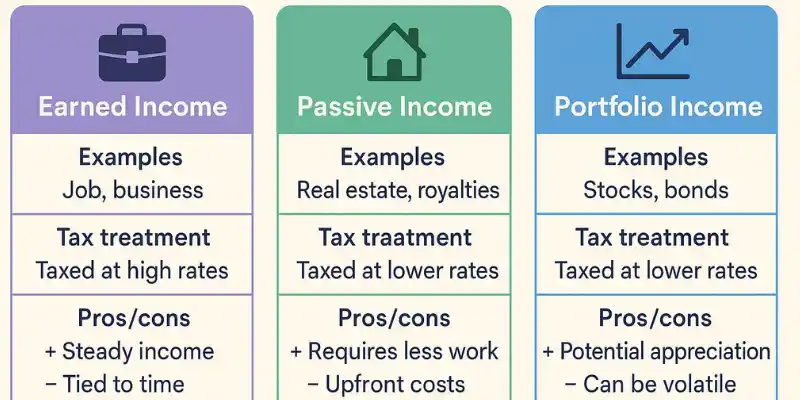
The IRS sorts income into buckets, and a passive loss only works inside its own bucket.
| Type | Common examples | Can passive activity losses offset it? |
| Passive income | Rental income; profit from a business you do not materially participate in | Yes |
| Nonpassive (active) income | Wages; self-employment income from a business you materially participate in | Generally no (the rental allowance is the exception) |
| Portfolio income | Interest, dividends, most royalties, gains from selling stocks and similar investments | No |
If you want the everyday side of this, our article on what passive income actually means covers the plain definition, and the one on active income covers the opposite end. Our list of common examples of passive income shows what people usually mean in everyday talk. Be aware that ‘passive income’ in everyday talk, like dividends or an online store you built, is not always ‘passive’ under tax law. That mismatch trips up many people.
How a Passive Loss Works, Step by Step

The process follows a set order:
- Basis and at-risk limits come first. The IRS says you must figure deductions disallowed under the basis and at-risk rules before you apply the passive limits. Thomson Reuters describes the same order.
- Add up passive income and passive deductions across all your passive activities.
- Net them. Gains in one passive activity can absorb losses in another.
- Apply the special allowance if you actively participated in rental real estate (covered below).
- Carry forward whatever is left.
Here is a simple illustration. Say a taxpayer has $6,000 of income from a limited partnership and a $14,000 loss from a rental. The partnership income absorbs part of the rental loss, leaving a net loss of $8,000 from passive activities. Whether that $8,000 can reduce wages depends on the allowance rules in the next section.
Can Passive Losses Offset Ordinary Income?
Usually not. Passive losses can offset passive income, but they generally cannot reduce wages or the profit from a business you run yourself. The main exception is the rental allowance below.
Can Passive Losses Offset Capital Gains?
It depends on which kind of capital gain.
- Gains from selling stocks, funds, or other investments are portfolio income, and a passive loss cannot offset them. The IRS excludes gain from property held for investment from passive activity income.
- Gain from selling a passive activity itself, or property used in one, is generally passive income, so those losses can offset it.
That split is the reason one tax advisor may say yes and another may say no to the same question. They are often talking about different kinds of gain.
The $25,000 Special Allowance for Rental Real Estate
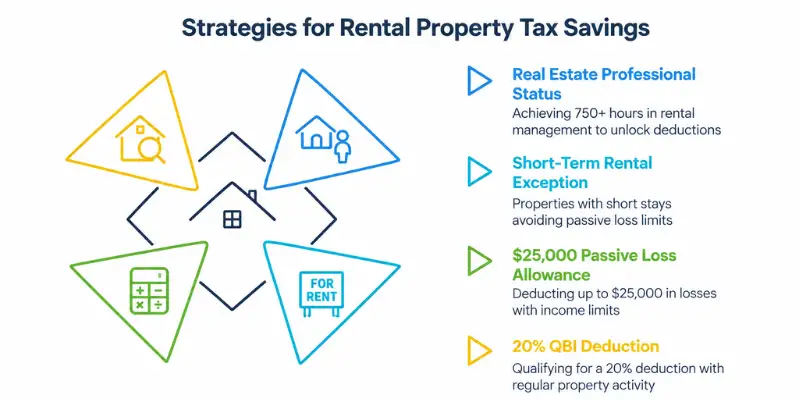
Here is the exception most landlords care about. If you or your spouse actively participated in a passive rental real estate activity, you can deduct up to $25,000 of that passive loss against nonpassive income, such as wages.
Active participation is a lower bar
Active participation is not the same as material participation. You can qualify by making management decisions in a real, good-faith way, like approving tenants, setting rental terms, or approving repairs. You must also have owned at least 10% of the activity throughout the year. Limited partners generally do not qualify.
The income phaseout
The allowance shrinks as your modified adjusted gross income (MAGI) rises:
| Modified AGI (single or joint) | Maximum allowance |
| $100,000 or less | $25,000 |
| $120,000 | $15,000 |
| $150,000 or more | $0 |
The allowance drops by 50 cents for every dollar of MAGI above $100,000. For married people filing separately who lived apart all year, the numbers are cut in half: a $12,500 allowance that phases out between $50,000 and $75,000. If you lived with your spouse at any time during the year and file separately, you cannot use the allowance to reduce nonpassive income.
MAGI here has its own definition. It is your adjusted gross income figured without items such as taxable Social Security benefits, deductible IRA contributions, the student loan interest deduction, and the passive activity income or loss itself.
A worked example
Take a single taxpayer with $140,000 of modified AGI. The $40,000 above the $100,000 line cuts the allowance by $20,000, which leaves $5,000. If the net rental loss is $8,000, then $5,000 is deductible this year and $3,000 carries forward. The same taxpayer with $155,000 of MAGI would get no allowance, and the full $8,000 would carry forward.
That is why a bonus or other income near the phaseout range can change how much of a rental loss you can use.
What Are Suspended Passive Losses?
A suspended passive loss, also called an unallowed loss, is the part of a passive loss you cannot deduct this year. It does not expire. Under the IRS carryover rule, disallowed deductions roll into the next year and are treated as deductions from that activity then.
That means a suspended passive loss can be used when:
- The activity earns income in a later year.
- You have income from other passive activities.
- You sell your whole interest in the activity (next section).
- The activity stops being passive for you. The old loss can then offset that activity’s income.
Form 8582 is where prior-year unallowed amounts are tracked, so keep your copies.
What happens to suspended losses when you sell
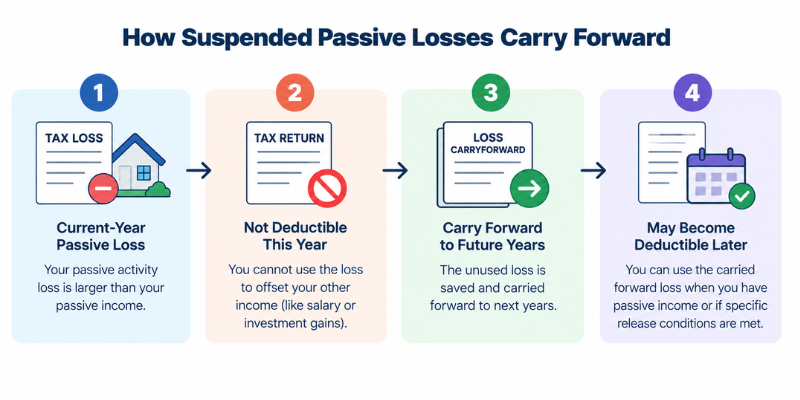
Unused losses, including this year’s, are generally allowed in full in the year you dispose of your entire interest in the activity. Three conditions apply:
- You must dispose of your entire interest.
- It must be a transaction in which all realized gain or loss is recognized.
- The buyer cannot be related to you.
A partial sale generally does not release them. The IRS says that disposing of less than substantially all of an entire interest does not trigger the allowance of prior-year unallowed losses.
If you sell at a capital loss, the capital loss limits still apply. For individuals, the capital loss deduction is limited to your capital gains plus up to 3,000(1,500 if married filing separately). In the IRS example in Publication 925, a $12,000 capital loss on the sale of a partnership interest produced a $3,000 allowable capital loss, and the other $9,000 carried over under the capital loss rules.
Because the sale must be fully taxable, a tax-deferred swap such as a like-kind exchange may not release suspended losses. Ask a tax professional before you rely on it.
Real Estate Professional: The Big Exception
If you qualify as a real estate professional, rental real estate activities in which you materially participate are not passive. Their losses can then offset other income. You need to meet both of these:
- More than half of the personal services you performed in all your jobs and businesses were in real property trades or businesses in which you materially participated.
- You performed more than 750 hours of services in those real property trades or businesses.
Employment hours generally do not count unless you own more than 5% of the employer. On a joint return, your spouse’s services are not added to yours for these two tests, although their participation can count toward material participation in a specific rental.
For many people with a full-time job, the ‘more than half’ test is the barrier. A 40-hour-a-week employee would need to put in more real estate hours than job hours. Thomson Reuters notes that these rules are technical and heavily scrutinized, so keep good records. If this might fit you, read up on passive real estate investing first, then confirm with a tax advisor.
How Grouping Activities Affects Passive Loss Treatment
You can treat more than one trade or business, or more than one rental, as a single activity if they form an appropriate economic unit. This matters because you only need to show material participation in the group as a whole, instead of in each activity on its own. The IRS looks at things like the type of business, common control and ownership, location, and how much the activities depend on each other.
Three cautions apply:
- Once you group activities, you generally cannot regroup in later years unless the grouping was clearly inappropriate or the facts changed in a material way.
- You must file a written disclosure statement when you first group or change a grouping. If you skip it, each activity can be treated as separate.
- The IRS can regroup your activities if one of the main purposes of your grouping is to avoid the passive rules.
A rental can generally be grouped with a trade or business only in narrow cases, such as when one is insubstantial compared with the other. Grouping choices can last for years, so get professional help before you make one.
Is Your Side Hustle Loss a Passive Loss?
This is where HustleIdeasHub readers often get confused. Most side hustles you run yourself are not passive in the tax sense, because you work in them. A freelance writer, a tutor, or a delivery driver would usually meet a material participation test, so those results are usually not a passive loss at all.
An online project can go either way. If you build and run an online store yourself, it is usually nonpassive. If you only put in money and do not take part in running it, it may be passive. Our guide to online passive income shows how much work these ideas can take.
Here is how different setups tend to line up:
| Setup | Likely tax treatment | Why |
| Rental house you manage | Passive (rental), $25,000 allowance may apply | Rentals are passive by default |
| Limited partner in a business | Usually passive | Limited partners are generally treated as not materially participating |
| Money invested in a friend’s company where you do not work | Often passive | Investor-only work does not count |
| A store or service you run and work in yourself | Often nonpassive | Hours and involvement meet a participation test |
| Dividend stocks and interest | Portfolio income | Not passive activity income, so rental or partnership losses cannot offset it |
That last row matters if you are building income from dividend stocks. Those dividends are portfolio income for this purpose, so a rental loss cannot offset them.
For how the income side of passive streams is taxed, see our guide on how passive income is taxed. If you are still picking what to start, browse our side hustle ideas and think about how much of your own time each one would need, since your hours decide a lot of the tax treatment.
How to Report a Passive Loss
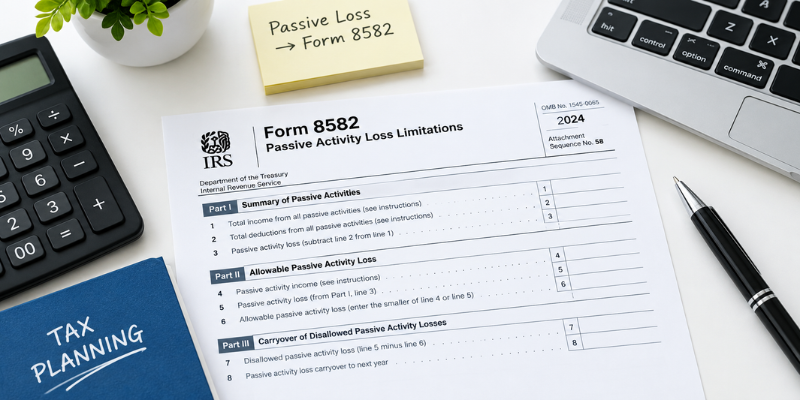
Individuals, estates, and trusts use Form 8582, Passive Activity Loss Limitations, to figure the current-year loss and report prior-year unallowed amounts. The Instructions for Form 8582 explain the steps line by line.
You may not need the form at all. The instructions say you can skip Form 8582 if all of these are true:
- Rental real estate with active participation was your only passive activity.
- You have no prior-year unallowed losses from it or any other passive activity.
- Your total loss from those rentals was not more than 25,000(12,500 if married filing separately and living apart all year).
- Your modified AGI was not more than 100,000(50,000 if married filing separately).
- You have no current or prior-year unallowed passive credits.
- You hold no interest in rental real estate as a limited partner or as a beneficiary of an estate or trust.
Check the full list in the instructions before you skip the form. A few related points:
- Rental and partnership amounts usually start on Schedule E before they feed into Form 8582.
- At-risk limits (Form 6198) come before passive limits.
- After the passive rules, an excess business loss limit may apply, reported on Form 461.
- If a rental is not passive for the year, any earlier unallowed loss is treated as a loss from a former passive activity. You can deduct it up to that activity’s current net income.
Tax software can fill in the form, but it can only work with the hours and ownership facts you give it.
Do State Rules Treat a Passive Loss the Same Way?
Not always. Your state may follow the federal result or adjust it. For example, the Wisconsin Department of Revenue guidance explains that the passive loss it allows depends on Wisconsin’s own definition of the Internal Revenue Code. Some taxpayers there must file a Schedule I and recompute Form 8582 for state purposes. One cause is a difference in depreciation rules, because depreciation changes the income or loss that feeds the calculation. Check your own state’s tax agency for its rules.
Common Mistakes With Passive Loss
- Assuming a rental loss always reduces your wages. Above the phaseout range, it does not.
- Mixing up active and material participation. They are different tests with different thresholds.
- Forgetting the carryover. Suspended losses help only if you track them from year to year.
- Calling every low-effort income stream ‘passive.’ The tax label depends on your participation, not on how relaxed the work feels.
- Counting investor-type work as hours. Reviewing statements generally is not participation.
- Regrouping activities without disclosure. Grouping rules have written-statement requirements, and failing to disclose can make each activity count as separate.
- Selling too early, selling only part, or selling to a relative. None of these frees suspended losses the way a full sale to an unrelated buyer can.
- Applying the limits in the wrong order. Basis and at-risk limits come before the passive limits.
Who Should Pay Closest Attention
- Landlords with one or more rental properties, especially with income near $100,000 to $150,000.
- Limited partners and silent investors in small businesses.
- Anyone receiving a Schedule K-1 with a loss from a partnership or S corporation.
- People planning to sell a rental or a business interest, since that sale can release suspended losses.
If you only work for wages and run a side hustle you do yourself, these rules may never touch you. Still, once you start owning rentals or buying into other people’s businesses, they matter.
Passive Loss Rules Outside the United States
Everything above comes from US federal law. Other countries tax rental and business losses in their own ways, and the outcomes can be very different. Two examples:
- United Kingdom: HMRC’s Property Income Manual says a rental business loss is generally carried forward and set against profits of the same property business. Except in limited cases, it cannot be used against general income. See the HMRC guidance on property losses.
- Australia: The Australian Taxation Office says a net rental loss on a negatively geared property can often be deducted against other income, such as salary, and any excess is carried forward. Rules change, so confirm the current position on the ATO website.
These are only two examples, and many other countries have their own rules. Before you assume any US-style passive loss rule applies to you, check with your national tax authority or a local tax professional.
If you are not a US resident but hold US rental property or a US business interest, this guide does not cover how the rules apply to you. Get advice that fits your situation.
Conclusion
A passive loss is a loss the IRS lets you use mainly against passive income. Rentals are passive by default, businesses become passive when you do not materially participate, and a passive loss you cannot use right away carries forward until income or a full sale frees it. If you own rental property, the $25,000 allowance can help, but it phases out between $100,000 and $150,000 of modified AGI.
Before you decide a loss will lower your tax bill, check three things: how you participate, what your modified AGI looks like, and whether you will sell the activity soon. Then talk to a tax professional with your real numbers. Readers outside the US should check local rules first, since US passive loss limits may not apply to them at all.
Faq
It is a tax loss from rentals, or from a business you do not materially participate in. You can generally use it only against passive income.
It is the amount by which your deductions from passive activities are higher than your income from them for the year. Form 8582 is used to work it out.
Generally no. The main exception is the rental real estate allowance of up to $25,000 for people who actively participate and fall under the income limits.
It can offset gain from selling a passive activity, but not portfolio gains such as profit from selling stocks or funds.
Yes. The disallowed part carries to the next year, and keeps carrying until you have enough passive income or you dispose of the activity.
If you sell your entire interest to an unrelated person in a fully taxable transaction, the suspended losses are generally allowed in that year. Capital loss limits can still apply to a loss on the sale itself.
Active participation is the lower bar. It is about making real management decisions in a rental and owning at least 10%. Material participation is the stricter test, built around hours and involvement, and it is used for businesses.
Look at the prior-year Form 8582 and your tax return worksheets, which track the unallowed amounts by activity.
No. Some landlords with small rental losses and modified AGI of $100,000 or less can skip it. The Form 8582 instructions list every condition.
Generally yes. A loss from a business in which you materially participate is not a passive loss, so these limits do not apply to it. Other limits, such as basis and at-risk rules, can still apply.
