

There is a flood of content right now claiming that AI tools for passive income are the easiest way to make money online. This is separate from the category of passive income apps that pay you for investing or sharing resources. AI tools are creation tools. Passive income apps are earning platforms. Both are useful, but they do very different things. Most of it is exaggerated. AI does not generate passive income by itself. What AI actually does is shrink the amount of time it takes to build the things that generate passive income, writing, design, video, and research.
That distinction matters enormously. A tool that helps you write a blog post faster is not the same as a tool that earns you money while you sleep. The blog post still needs to rank in search results, still needs to genuinely help the reader, and still needs traffic before it earns anything at all. AI speeds up the creation. It does not replace the strategy or the audience-building underneath it.
This article covers the AI tools for passive income that genuinely move the needle, what they actually do, realistic earning expectations, and the honest limitations that most promotional content leaves out.
Table of Contents
The Real Relationship Between AI and Passive Income
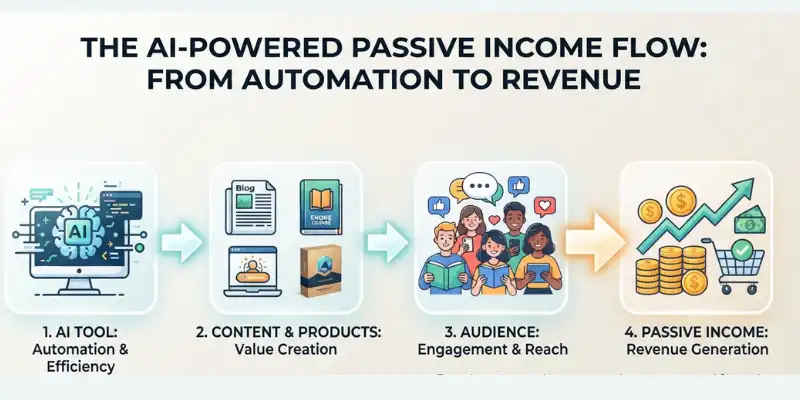
Before getting into specific tools, it helps to understand the actual mechanism at work. AI tools for passive income work in four main ways, and they map almost directly onto the most common passive income categories that people actually build, content, digital products, services, and investments.
They speed up content creation, letting you produce blog posts, video scripts, and social content faster than writing or recording everything manually. They reduce design and production costs, letting you create graphics, audio, and video without hiring specialists. They automate repetitive tasks through tools that connect different systems together, like automatically posting content or processing customer inquiries. And they lower the skill barrier for tasks that used to require specialized training, like video editing or voice recording.
The real shift AI enables is compressing the active phase of building. All passive income starts with active work and effort before it becomes passive. AI tools shorten how long that active phase lasts. None of these four things directly creates passive income. They all reduce the upfront cost of building the actual income-generating asset, whether that is a blog, a digital product, a YouTube channel, or an automated service. The passive income still comes from that underlying asset, not from the AI tool itself.
AI Tools for Passive Income That Genuinely Work
ChatGPT for Content Creation
ChatGPT remains the most versatile starting point for AI-assisted passive income work. It writes blog post drafts, product descriptions, email sequences, and digital product outlines significantly faster than writing from scratch.
The realistic use case is pairing ChatGPT with a content platform you already control, a blog, an Etsy shop, an email list, rather than expecting the tool itself to generate income. Writers who use ChatGPT to draft initial content and then edit and refine it for quality and accuracy report content production times cut by 40 to 60 percent compared to writing everything manually.
The honest limitation: content that is purely AI-generated with no editing or genuine insight tends to underperform in search rankings and reader engagement. The tools that actually translate into income are the ones used to accelerate a human’s judgment, not replace it entirely.
Canva AI for Digital Product Creation
Canva’s AI features make creating digital products, planners, templates, social media graphics, and printable designs dramatically faster than starting from a blank page. For anyone building a catalog of digital products to sell online, Canva is one of the most directly useful AI tools available, since it produces the actual sellable asset rather than just supporting content around it.
A digital planner that might have taken six to eight hours to design manually can often be completed in two to three hours using Canva’s AI-assisted layout and design suggestions. That time savings compounds across a product catalog, letting sellers list more products in less time.

ElevenLabs for Voice and Audio Content
ElevenLabs converts written scripts into realistic, human-sounding voiceovers, removing the need to record your own voice for video content, audiobooks, or podcasts. This has opened up passive income paths for people who have strong writing or research skills but are uncomfortable on camera or behind a microphone.
Creators using AI voice tools for YouTube content, audiobook narration, or course videos report being able to produce significantly more content in the same amount of time, since recording and re-recording takes longer than generating and lightly editing an AI voiceover. Monthly income potential from voice-driven content varies enormously depending on the platform and audience size, but the tool itself removes one of the biggest production bottlenecks in content-based passive income.

Midjourney and AI Image Generation for Stock Content
AI image generation tools let creators build a library of stock images, digital art, or print-on-demand designs without needing traditional design skills or expensive photography equipment. Stock photography platforms increasingly accept AI-generated images, and print-on-demand sellers use AI art for merchandise designs.
The realistic income here builds slowly, similar to traditional stock photography. A library of 200 to 500 well-tagged AI-generated images can produce $100 to $500 per month in royalties once established on platforms that pay per download or license.
Zapier and Make for Workflow Automation
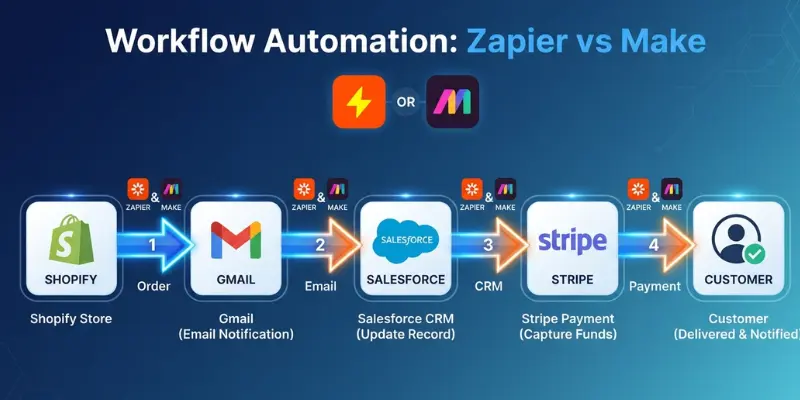
Beyond content creation, AI-enhanced automation platforms like Zapier and Make let you connect different tools together so that tasks happen automatically without manual triggering. For people running a digital product business or a service-based side hustle, this means orders get processed, emails get sent, and inventory gets tracked without daily manual intervention.
The income opportunity here is twofold. First, automation reduces the ongoing time required to run an existing passive income stream, making it genuinely more passive. Second, some people build entire small businesses around setting up these automations for other companies, charging $500 to $2,000 per automation project, which is active income that can fund other passive projects.
AI-Assisted SEO and Research Tools
Tools that combine AI with search data, helping identify what topics people are actually searching for and what gaps exist in current search results, have made it considerably faster to research and plan content that has a real chance of ranking and earning. This matters because content that nobody searches for will never generate passive income, no matter how well it is written.
Using AI research tools to identify underserved topics before writing, rather than guessing, meaningfully improves the odds that a piece of content actually performs well enough to generate ongoing traffic and income.
How AI Tools for Passive Income Actually Translate to Money
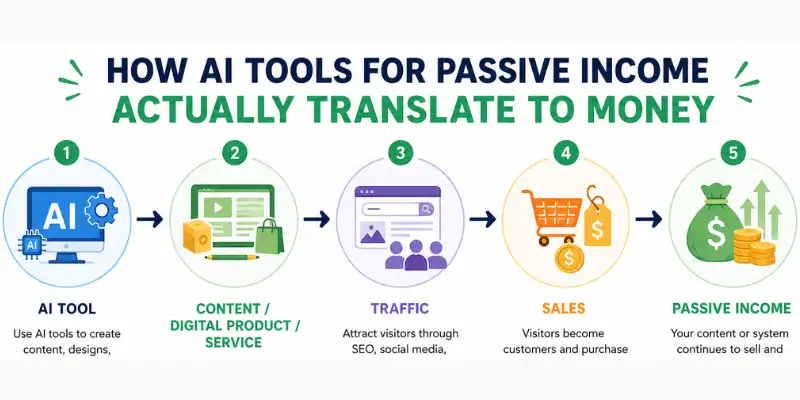
The honest path from AI tool to actual income runs through one of these models, and it helps to be clear about which one you are pursuing.
Content Creation at Scale
AI tools help you publish more frequently across blogs, YouTube, or social platforms without burning out. More published content, assuming it is genuinely useful, means more opportunities to rank in search results and attract an audience. The income then comes from advertising, affiliate commissions, or product sales connected to that content, not from the AI tool itself.
Digital Product Creation
AI design and writing tools speed up the creation of sellable digital products, planners, templates, ebooks, and courses. The income comes from selling those products on platforms like Etsy, Gumroad, or Teachable. The AI tool reduces the time between idea and finished, sellable product.
Some people also use AI research tools to analyze and track investment portfolios, including dividend stock portfolios built for passive income, where AI can surface company financial data, compare yields, and flag changes in payout history faster than manual research.
Service-Based AI Consulting
Some people use their familiarity with AI tools to offer services to businesses that want to adopt AI but do not know how. Building simple automations, training small teams, or setting up AI-powered customer support are all active income streams initially, but they can become semi-passive through retainer agreements and recurring monthly contracts once a system is built and only needs occasional maintenance.
Faceless Content Channels
Combining AI voice generation, AI image creation, and AI scriptwriting lets some creators build YouTube channels, podcasts, or social content without appearing on camera themselves. This category has real income potential but also the most overhyped claims, since channels that rely entirely on automated content with no genuine editorial judgment tend to underperform compared to channels with real human insight behind the automation.
Realistic Income Expectations From AI Tools for Passive Income
Being honest about timelines and numbers matters more here than in almost any other passive income category, because the marketing around AI tools tends toward exaggeration.
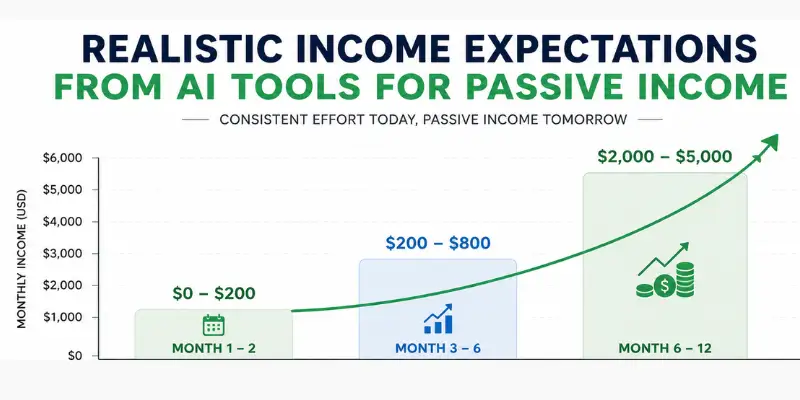
Most beginners using AI tools for content or product creation see $0 to $200 per month in their first one to two months. This period is almost entirely setup and initial traffic building.
By month three to six, with consistent output, $200 to $800 per month becomes realistic for people combining AI-assisted content creation with a clear monetization plan, whether that is affiliate marketing, ad revenue, or product sales.
Intermediate users who combine multiple AI-assisted income streams, content plus digital products plus a small service offering, commonly reach $2,000 to $5,000 per month by month six to twelve, though this requires consistent effort across all three streams rather than passive waiting.
The honest caveat that most competing articles skip: none of these AI tools generate this income automatically. Every dollar in these ranges still required real strategic decisions, genuine content quality, and consistent execution. The AI accelerated the production. It did not replace the judgment behind what got produced.
RELATED POSTS
Passive Income App: Which Ones Actually Pay and Which Ones Waste Your Time
Examples of Passive Income: 20 Real Ways to Earn Money While You Sleep
What to Avoid With AI Tools for Passive Income
Fully automated content with zero human review. Search engines and audiences increasingly recognize and devalue content that shows no genuine human judgment or expertise. Tools that promise to generate and publish content with zero oversight tend to produce assets that underperform significantly.
AI crypto trading bots promising guaranteed returns. Any tool claiming guaranteed passive income from automated cryptocurrency trading deserves significant skepticism. Markets are unpredictable, and “guaranteed” returns in volatile markets are a red flag rather than a feature.
Tools that require constant prompting to function. A genuine AI tool for passive income should reduce ongoing time investment, not just shift the type of work you do. If a tool requires daily attention and constant adjustment to generate any output, it is closer to a more efficient form of active work than passive income.
Overpaying for tools before validating the income model. Many AI tools carry monthly subscription costs of $20 to $200. Before committing to multiple paid subscriptions, validate that your underlying content or product idea actually has demand using free tools first.
Combining AI Tools With Existing Passive Income Strategies
AI tools work best as an accelerant layered onto passive income strategies that already have a proven foundation, rather than as a standalone strategy on their own.
For people already building a focused content business around a specific topic, AI writing and research tools can meaningfully speed up content production, letting a blog reach the volume of content needed to rank competitively faster than manual writing alone would allow.
For people building a catalog of sellable digital products, AI design tools reduce the time per product significantly, which is one reason this model has become especially popular among women who want income that builds around their schedule rather than requiring fixed hours at a desk, which means a larger catalog can be built in the same number of hours, directly increasing the number of potential income streams.
For people exploring the full range of ways to earn income outside a regular job, understanding which AI tools genuinely accelerate real work, versus which ones are marketed with unrealistic promises, prevents wasted time and money on subscriptions that do not move the needle.
The pattern that holds up across every successful use of AI tools for passive income is the same: pick a real income model first, then use AI to build it faster. Picking a tool first and hoping an income model appears around it rarely works.
How to Start Using AI Tools for Passive Income This Week
Choose one passive income model you actually understand and believe in, whether that is digital products, blog content, or a service offering. Identify the single most time-consuming part of building that model, writing, design, voice recording, or research.
Test one free or low-cost AI tool that addresses that specific bottleneck. Use it to produce your first real asset, a blog post, a digital product, a short video, this week rather than spending more time researching which tool is theoretically best.
Track how much time the tool actually saved you compared to doing the task manually. This tells you whether the tool genuinely accelerates your specific income model or whether it is adding complexity without real benefit.
The honest starting point for building any kind of income that works for you over time is the same with or without AI involved. And just as starting any income-building project requires choosing one concrete first action rather than endlessly researching options, the same rule applies here. Start with one method, execute consistently, and let the early months of slow results be the proof that you are building something real rather than chasing a shortcut.
Conclusion: AI Tools Help You Build Faster, Not Effortlessly
AI tools for passive income are genuinely useful, but not in the way most promotional content suggests. They do not generate income on their own. They compress the time between having an idea and having a finished, sellable asset, whether that is a piece of content, a digital product, or an automated workflow.
The people seeing real results from AI tools for passive income are not the ones who found a magic tool. They are the ones who already understood a real income model, real audience needs, and real monetization paths, and then used AI to execute that understanding faster than they could have manually.
Pick a model. Use AI to accelerate the slowest part of building it. And give the underlying asset, not the tool, the time it needs to actually start earning. That is the honest version of how AI tools for passive income actually work.
Frequently Asked Questions About AI Tools for Passive Income
Can AI tools really generate passive income on their own?
No. AI tools help create content, products, or automated workflows, but the income comes from the assets you build. AI is a productivity tool, not a guaranteed source of passive income by itself.
What are the best AI tools for passive income right now?
Popular choices include ChatGPT for writing, Canva AI for design, ElevenLabs for voice generation, Midjourney for images, and Zapier or Make for workflow automation. The best tool depends on your passive income strategy.
How much money can you make with AI tools for passive income?
Earnings vary based on your niche and consistency. Beginners often earn $0–$200 per month initially, while experienced creators using multiple AI-assisted income streams may generate $2,000–$5,000 or more per month.
Do AI tools for passive income cost money?
Many AI tools offer free plans that are suitable for beginners. Premium versions typically cost between $10 and $50 per month, making it a good idea to validate your business idea before paying for multiple subscriptions.
Is fully automated AI content a good passive income strategy?
Generally, no. Content created without human editing often performs poorly in search engines and provides less value to readers. The best results come from combining AI with human expertise and quality control.
What is the fastest AI-assisted passive income method to start?
Creating digital products with AI design tools like Canva is one of the fastest methods because products can be created and listed for sale within a few days.
Are AI crypto trading tools a legitimate passive income source?
Be cautious. Any platform promising guaranteed profits from AI-powered crypto trading should be viewed skeptically. Cryptocurrency markets are unpredictable, and no legitimate system can guarantee returns.
How do I know if an AI tool is actually helping my passive income or just adding cost?
Measure how much time the tool saves and whether it improves the quality or performance of your work. If it doesn’t increase productivity or results, it may simply be an unnecessary expense.

1 Comment
Pingback: What Is Passive Loss? Rules, Limits & Examples