

Everyone talks about earning money while they sleep. But most people have no idea what that actually looks like in practice or how realistic it is to achieve.
Passive income is not a myth, but it is also not magic. Almost every example of passive income requires either money upfront, time upfront, or skills applied upfront. What makes it passive is that the work you put in once keeps generating returns long after you stop actively working on it.
This article covers 20 real examples of passive income, how each one works, what it takes to get started, and who each approach makes the most sense for. If you have been searching for the right passive income idea for your situation, this is a practical place to start.
Table of Contents
What Is Passive Income and How Does It Work
Passive income is money earned with little or no ongoing effort after an initial setup. It sits on the opposite end of the spectrum from active income, where you trade hours for dollars. With passive income, the income continues even when you are not actively working.
It is worth being honest about something most passive income content leaves out: almost nothing is completely passive from day one. Most passive income sources require real effort or investment at the start. The payoff is that once set up properly, they generate returns that are not tied to your time.
The difference between passive income and a side hustle is not always obvious. A side hustle, like working as a virtual assistant or doing freelance writing, pays you for the time you actively spend. Passive income, like collecting rent from a property or receiving dividend payments, keeps coming whether you worked that day or not. Many people running a virtual assistant side hustle use their active income earnings to invest in passive income vehicles, building both streams at once.
Understanding this distinction also matters for how you plan your time. Active income from a side hustle pays you now. Passive income pays you later, often for a very long time.
Investment-Based Examples of Passive Income
These passive income examples involve putting money to work rather than time. They generally require capital upfront but can generate income with minimal ongoing management.
Dividend Stocks
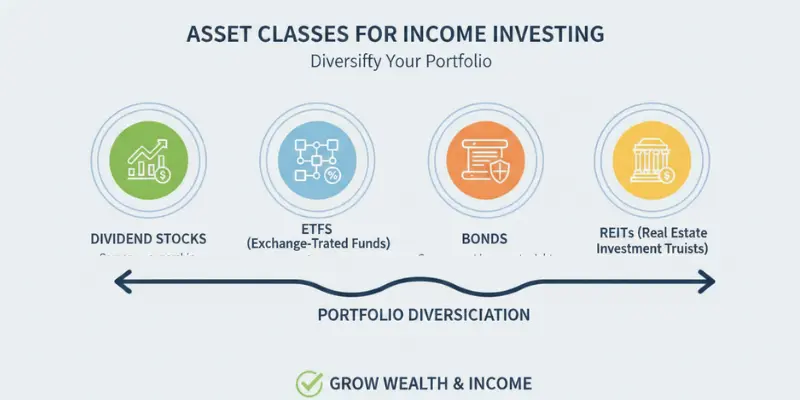
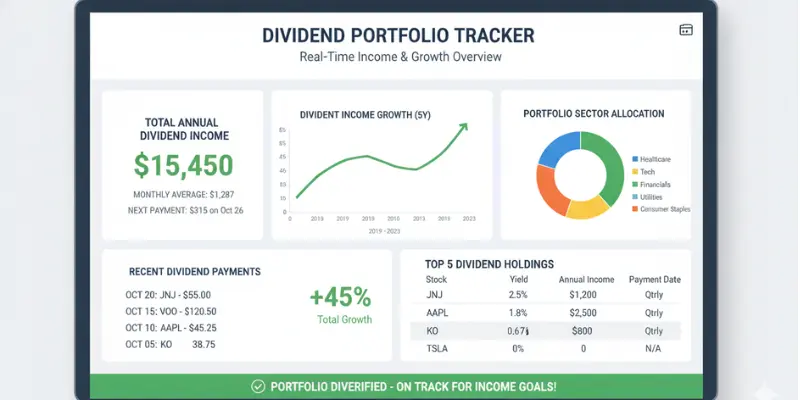
Dividend stocks pay you a portion of the company’s profits on a regular basis, usually quarterly or monthly. You buy shares in a company, and as long as you hold those shares, dividend payments arrive in your account automatically.
The key is choosing dividend stocks with sustainable payout ratios, long histories of consistent payments, and businesses that can continue generating strong cash flow over time. Many investors build a portfolio of high-yield dividend stocks specifically to generate passive income that grows every year.
Dividend stocks are among the most liquid examples of passive income because you can sell shares at any time. They also benefit from compounding when you reinvest dividends to buy more shares. Investors who want a thorough understanding of how to pick, evaluate, and build a portfolio around dividend stocks for passive income will find that the approach rewards patience more than anything else.
Dividend Index Funds and ETFs
Not everyone wants to research individual dividend stocks. Index funds and ETFs that focus on dividend-paying companies offer a simple way to get exposure to dozens or hundreds of dividend stocks through a single purchase.
These funds automatically diversify your dividend income across many companies and sectors, reducing the risk that any single dividend cut hurts your overall income significantly.
High-Yield Savings Accounts and CDs
Not the most exciting examples of passive income, but savings accounts and certificates of deposit require zero ongoing management. You deposit money, and the bank pays you interest.
During higher interest rate environments, high-yield savings accounts and CDs can generate meaningful passive income with virtually no risk. They are best suited for money you want to keep safe while still earning something.
Bonds and Bond Funds
Bonds pay regular interest to investors. Corporate bonds, government bonds, and municipal bonds all offer predictable income payments on a set schedule. Bond funds make it easy to invest in many bonds at once.
While bond yields are generally lower than dividend stocks, bonds typically carry less volatility. Many income investors hold a mix of dividend stocks and bonds to balance growth potential with stability.
Passive Real Estate Investing
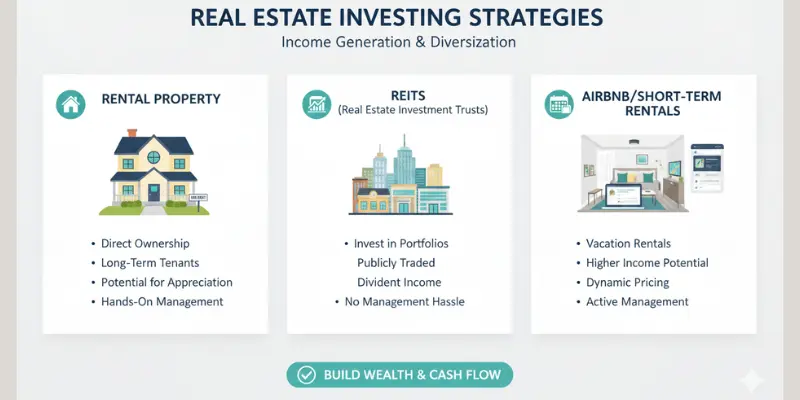
Real estate generates passive income in several ways. Direct rental properties are one option, though managing tenants and maintenance makes them more active than many passive income examples. Real estate investment trusts, or REITs, are a more hands-off approach: you invest in real estate companies the same way you invest in stocks, collecting regular dividends from rental income without owning or managing any physical property.
For those interested in owning real estate without the active landlord responsibilities, passive real estate investing through REITs and crowdfunding platforms has made it easier to access this income source with smaller capital requirements than traditional property ownership.
Peer-to-Peer Lending
Some platforms allow individuals to lend money directly to borrowers and earn interest on those loans. The interest rates can be higher than traditional savings products, but the risk is also higher since borrowers can default.
Peer-to-peer lending works best as a small portion of a diversified passive income portfolio rather than a primary income source.
Digital and Online Examples of Passive Income
These passive income examples require time and effort upfront rather than large amounts of capital. The payoff comes over time as the digital asset continues generating income after the initial work is complete.
Creating a Blog With Affiliate Income
A blog that ranks well in search engines can generate passive income through affiliate commissions and advertising revenue long after the articles are written. When readers click affiliate links in your posts and make purchases, you earn a commission.
The time investment is significant upfront. Writing quality content, building an audience, and earning search engine rankings takes months or years of consistent effort. But once the content is established and ranking, a single article can earn affiliate income for years with minimal updates.
Many people who treat blogging as a serious income stream eventually find it shifts from active work to something much closer to passive. Those who want to understand what that transition looks like in practice can find it useful to see how a blogging side hustle evolves from daily effort into a system that earns without constant attention.
YouTube Channel
Videos uploaded to YouTube can continue earning advertising revenue for years after they are published. Once a channel qualifies for the YouTube Partner Program, the monetized videos generate income every time someone watches them.
Building a YouTube channel that generates meaningful passive income takes time and consistency upfront. But popular videos can earn for a very long time with no additional effort after publishing.
Selling Online Courses
If you have expertise in any subject, packaging that knowledge into an online course is one of the more scalable examples of passive income. You create the course once and sell it repeatedly to an unlimited number of buyers.
Course platforms handle payment processing, video hosting, and student management. Your ongoing role after launch is mostly marketing and occasional content updates.
Teachers who already explain complex subjects for a living are particularly well positioned for this. Many educators who run side hustles for teachers begin by selling lesson plans or tutoring, then use those earnings and that expertise to build courses that keep earning long after they are created.
Writing and Self-Publishing Books
A well-written book can generate royalties for years or decades. Self-publishing platforms like Amazon Kindle Direct Publishing allow anyone to publish an e-book or print book and earn royalties on every sale, with no publisher required.
The royalty rates for self-published e-books can be as high as 70% per sale, making this one of the higher-margin digital passive income examples. Writers who produce multiple books tend to see compounding income as each new title brings readers back to discover previous work.
Selling Digital Products
Templates, printables, spreadsheets, design files, photography presets, and similar digital products can be created once and sold endlessly. Platforms like Etsy, Gumroad, and similar marketplaces handle transactions and delivery automatically.
A well-designed template that solves a common problem can continue selling for years with minimal updates. The challenge is creating products that enough people are actively searching for and buying.
Stock Photography and Video
Professional photographers and videographers can license their work through stock media platforms. Every time someone downloads and licenses your photo or video clip, you earn a royalty.
Building a large library of sellable images or video clips increases the likelihood of consistent sales over time. Niche content that is hard to find tends to earn more consistently than generic stock imagery.
App Development and Software
Creating a mobile app or software tool that solves a real problem can generate ongoing revenue through purchases, subscriptions, or in-app advertising. After the initial development, updates are periodic rather than constant.
This requires technical skills or the budget to hire developers, but a successful app can generate passive income for many years. Engineers with coding skills who already run side hustles for engineers sometimes find that a tool they built for themselves turns into a product other people are willing to pay for.
Print-on-Demand Products
Print-on-demand services allow you to upload graphic designs to products like t-shirts, mugs, and posters. When someone orders, the platform prints and ships the product. You earn the margin between the base cost and your selling price, without handling inventory or fulfillment.
Starting a print-on-demand shop requires graphic design skills or a budget for a designer, along with marketing effort to drive traffic to your products. Once established, it runs largely on autopilot.
Freelance Writing Turned Into a Content Asset
Freelance writing itself is active work, paid by the hour or the word. But writers who build their own content sites, newsletters, or topic-specific publications can eventually turn that writing into a passive income asset.
The distinction is in ownership. Writing for clients earns you once. Writing content you own earns you indefinitely. Many people who start with freelance writing side hustles eventually pivot some of their effort toward building content they own, specifically because of how different the income potential is over time.

Real-World Examples of Passive Income From Property and Assets
These passive income examples involve owning physical or intellectual assets that generate returns.
Rental Income From Property
Owning residential or commercial rental property is one of the oldest and most proven examples of passive income. Tenants pay rent monthly, and after covering the mortgage, insurance, taxes, and maintenance, the remaining amount is income.
The word “passive” is a stretch with direct rental properties. Vacancies, maintenance issues, and tenant problems require your attention. Many landlords hire property management companies to handle day-to-day operations, which makes the income more genuinely passive but reduces the profit margin.
Rental income tends to work best as a long-term play where the mortgage gets paid down over time, equity builds, and rents increase over the years.
Renting Out a Spare Room or Property
Platforms like Airbnb allow property owners to rent out spare rooms or entire properties to short-term guests. The income can be significantly higher than a traditional long-term rental, though it requires more active management unless you hire a co-host or management service.
For people with extra space or a second property, short-term rentals are a practical way to generate income from assets they already own.
Licensing Intellectual Property
If you have created something original, such as a song, photograph, illustration, software, or brand design, you can license others to use it in exchange for royalty payments.
Musicians earn royalties whenever their songs are streamed, played on the radio, or used in film and TV. Illustrators and photographers license their work for use in advertising, publishing, and digital media. Inventors and businesses license patented processes or branded products to other companies.
Licensing requires upfront creative or inventive work and often requires legal help to protect and manage the intellectual property, but the income can continue flowing for many years.
Vending Machines and ATMs
Owning vending machines or ATMs placed in high-traffic locations generates income from each transaction with minimal ongoing involvement. The primary responsibilities are restocking, maintenance, and cash collection, which some owners outsource entirely.
The upfront cost per machine is significant, but successful placements in the right locations can generate consistent monthly income.
How to Choose the Right Passive Income Example for You
With so many passive income examples available, picking the right one depends on what you have to invest, which could be time, money, skills, or some combination of all three.
- If you have capital to invest: Dividend stocks, REITs, index funds, bonds, and rental real estate are natural starting points. Your money does the work.
- If you have skills and time but limited money: Digital products, blogging, online courses, stock photography, and YouTube require effort but not large upfront capital.
- If you have creative skills: Print-on-demand, self-publishing, licensing music or art, and digital products let you monetize what you create.
- If you have both capital and skills: Combining investment income with digital income often creates the most resilient and diversified passive income portfolio.
The best approach is not to pick one passive income example and hope it works, but to build multiple income streams over time. People who have truly achieved income independence rarely rely on a single source.
RELATED POSTS
Passive Real Estate Investing: How to Earn Real Estate Passive Income
How to Make a Passive Income: 25 Proven Ways to Earn Money While You Sleep (2026–2030)
How to Start Building Passive Income From Zero
Starting with passive income does not require a large amount of money or a revolutionary idea. What it requires is consistent action over time.
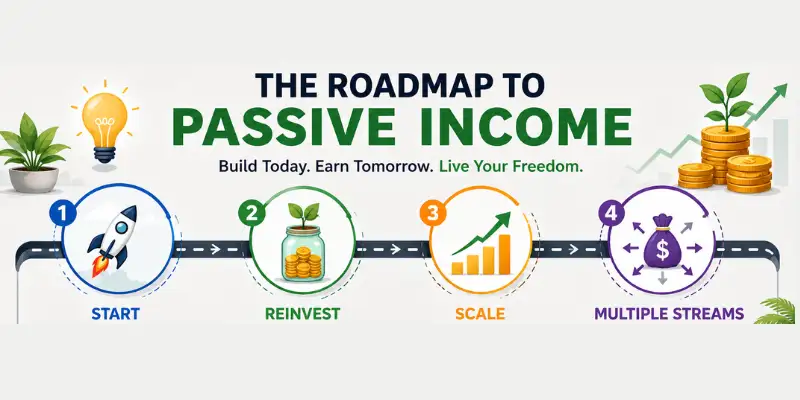
Start With What You Have
If you have some savings, explore dividend stocks or index funds as a starting point. Even a small amount invested consistently grows over time.
If you have skills or knowledge, consider whether a digital product, online course, or content site could turn that expertise into ongoing income.
Many people who eventually build significant passive income start by working a regular job or running a side hustle on the side, using that active income to fund their passive income investments over time. If you are still figuring out where to begin with any of this, understanding how to make a passive income from scratch is a useful first step before committing to any specific approach.
Reinvest Early Returns
In the early stages, the income from passive sources is usually small. Reinvesting those early returns rather than spending them accelerates growth significantly through compounding.
The investor who reinvests their dividend payments buys more shares, which generates more dividends, which buys even more shares. The blogger who reinvests time into improving existing content earns better rankings and higher traffic over time.
Add Streams Over Time
One passive income stream is a good start. Multiple streams make it reliable. As each income source becomes established, adding another gives you income from different places that does not all go up or down at the same time.
Students who combine part-time work with building digital assets and small investments are setting up multiple income streams from the beginning. Even those running a side hustle for students often discover that some of their side work can be converted into more passive forms of income with the right strategy.
People who work remotely have a natural advantage here too. Those already familiar with remote side hustles often find it easier to transition some of that work into digital passive income because the infrastructure is already in place.
Realistic Expectations for Passive Income in 2026
The most important thing to understand about passive income examples is that none of them produce overnight results.
Dividend investing takes years of reinvestment before it produces meaningful monthly income from a modest starting amount. Building a blog that earns from affiliate links takes months of consistent content creation before rankings and traffic develop. Creating and selling digital products requires marketing effort before a customer base develops.
The reason passive income is worth pursuing is not that it is fast. It is that the effort put in now compounds into more income over time, giving you more options and more financial flexibility later.
The most effective way to think about passive income is not as a replacement for your current income but as an additional layer of earnings that grows steadily alongside whatever you are already doing. Each year, the passive income becomes more meaningful. Each year, the income streams become more resilient.
Start small, stay consistent, and let time do the work that money and effort alone cannot.
Final Thoughts on Examples of Passive Income
Passive income comes in many forms, from dividend stocks and real estate to digital products and royalties. What all the best examples have in common is that they reward patience, initial effort, and smart choices made at the beginning.
Pick the approaches that match your current resources, whether that is capital, skills, time, or creativity. Start with one or two, build them properly, and add more streams as each becomes established.
The goal is not to find one magical source of passive income. The goal is to build a system where multiple streams of income arrive regularly without requiring your time every day. That is what financial freedom actually looks like in practice.
Whether you are a student, a working professional, or someone building toward retirement, the examples covered here give you a starting point. The rest is up to action.
Frequently Asked Questions About Passive Income
“`html❓ Frequently Asked Questions
What counts as passive income?
Passive income is any earnings that do not require active, ongoing effort to maintain. This includes dividends from stocks, rental income, royalties, affiliate commissions, and digital product sales.
Is passive income actually passive?
Mostly, yes, once it is established. However, nearly every passive income stream requires upfront work, time, or capital before it can generate ongoing earnings.
How much money do I need to start earning passive income?
The amount depends on the method. Dividend investing can start with a small amount, while rental properties typically require a larger upfront investment.
What is the easiest passive income for beginners?
High-yield savings accounts and dividend index funds are among the easiest options because they require little maintenance and no specialized skills.
How long does it take to build passive income?
The timeline varies. Some methods generate income immediately, while others, such as blogs and dividend portfolios, may take months or years to reach meaningful levels.
Can passive income replace a full-time job?
Yes, but it usually requires years of consistent investing, asset building, and diversification across multiple income streams.
What is the difference between passive income and a side hustle?
A side hustle requires active work to earn money, while passive income continues generating revenue from assets or systems you have already created.

1 Comment
Pingback: What Is Passive Loss? Rules, Limits & Examples