

Everyone has seen the ads. Download this app, earn money while you sleep, watch the dollars stack up while you do nothing. Most of those ads are selling you something. The app itself is usually the product, not a genuine tool for building income.
But genuine passive income apps do exist, ones built around real financial mechanisms rather than gimmicks. Some of them are simple investment platforms that pay dividends or interest automatically. Others share a portion of your unused internet bandwidth or device resources with third parties in exchange for monthly payments. A few are cashback or rewards apps that return money on purchases you were already making.
None of them are going to replace your income. They work best alongside the more substantial streams that come from building online passive income through content or products. But some of them genuinely put money in your account with minimal ongoing effort, and that is worth knowing about if you are building multiple small income streams alongside more substantial ones.
This article covers the passive income app that actually pay, what each one does, what you can realistically earn, and the honest limitations that most app reviews skip over.
Table of Contents
What to Look for in a Real Passive Income App
Before getting into specific apps, it helps to know what separates a genuine passive income app from one that wastes your time or, worse, puts your data or security at risk.
Most people start with active income from work they perform directly and add app-based passive income on top of it, letting the apps run in the background while the main job provides primary income. A legitimate passive income app has a clear, transparent business model. You should be able to understand exactly how the company makes money and why they are willing to share a portion of that revenue with you. Apps that cannot explain this clearly are worth avoiding.
Payouts should be verifiable. Look for apps with real user reviews that mention actual dollar amounts received, not just testimonials promising income. Independent reviews and documented payout records matter more than in-app earnings dashboards.
The income should require genuinely minimal ongoing action. If an app requires you to complete surveys, watch ads, or perform tasks every day to earn, that is active income at an extremely low hourly rate, not passive income.
Earnings should be proportional to something real. Investment apps pay returns on money invested. Bandwidth-sharing apps pay based on verified usage. Cashback apps return a percentage of actual purchases. If an app promises high passive income with no clear mechanism for generating it, the source of that income deserves scrutiny.

Best Passive Income Apps That Actually Work
Investment Apps That Pay Dividends and Interest
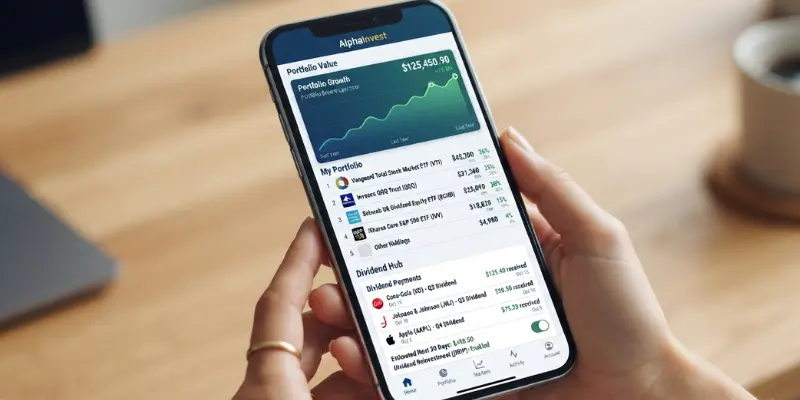
The most straightforward passive income apps are investment platforms that pay you returns on money you deposit. These are genuinely passive because once you deposit money and select your investment, the income arrives automatically.
Fidelity, Vanguard, and Charles Schwab are the most established options. All three let you open a brokerage account, purchase dividend-paying stocks or ETFs, and receive quarterly dividend payments directly to your account with no ongoing action required. They also allow you to hold high-yield money market funds that pay interest daily. These are not exciting apps in the traditional sense, but they are the most legitimate and verifiable way to earn genuine passive income through an app.
Acorns rounds up your everyday card purchases to the nearest dollar and invests the difference in a diversified portfolio. It is genuinely passive in practice, since the investing happens automatically from purchases you were already making. The portfolio pays dividends that are automatically reinvested. Returns match broad market performance. The monthly fee of $3 is worth noting, since it can eat into returns significantly on smaller balances.
Robinhood and Webull both offer high-yield cash management accounts paying 4 to 5 percent annually on uninvested cash, which makes them effective passive income apps for anyone who maintains a cash balance in a brokerage account. The interest accrues daily and requires no active management.
Understanding how dividend stocks generate passive income through these investment apps is the foundation behind this entire category. The app is simply the interface. The income comes from the underlying dividend-paying investment.
Bandwidth Sharing Apps
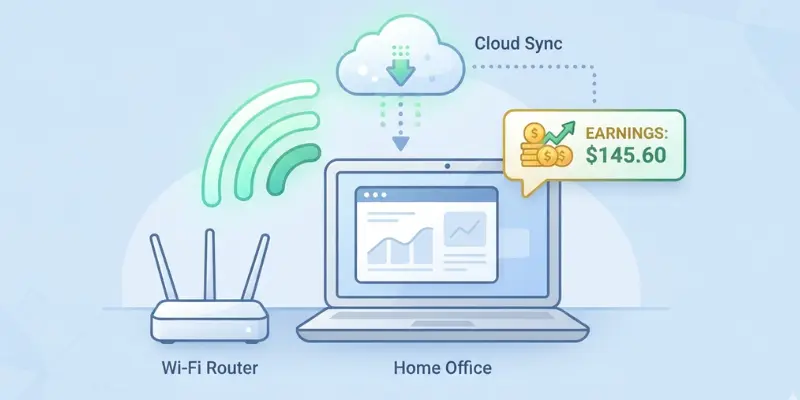
Several apps pay you to share a portion of your unused internet bandwidth with companies that use it for market research, ad verification, and similar purposes. These are genuinely passive since the app runs quietly in the background once installed.
Honeygain pays users for sharing unused internet bandwidth. The app runs in the background on your computer or phone, and you earn credits as your bandwidth is used. Credits convert to cash via PayPal at a rate of approximately $1 per 10GB of shared traffic. Realistic monthly earnings run $2 to $10 for most users, with higher earnings possible for users with fast, unlimited internet connections.
EarnApp by BrightData operates similarly, sharing your bandwidth with market research and ad verification clients. Earnings are slightly higher than Honeygain for comparable usage, with most users reporting $3 to $15 per month depending on connection speed, location, and how many devices are running the app simultaneously.
Pawns.app combines bandwidth sharing with optional surveys. The passive portion, bandwidth sharing, typically earns $1 to $5 per month. The survey component is active, lower-paying work that inflates the headline income figures compared to what the purely passive sharing produces.
The honest picture on bandwidth sharing apps: the income is genuinely passive but genuinely small. It works best as one small stream among several rather than a meaningful income source on its own.
Cashback and Rewards Apps
Cashback apps return a percentage of money you were already spending, which fits the passive income model since you are not changing your behavior to earn the reward.
Rakuten pays cash back on online purchases made through its platform. Cashback rates run from 1 to 15 percent depending on the retailer. For someone who regularly shops at Rakuten partner stores, annual cashback of $50 to $500 is realistic with no extra effort beyond clicking through the Rakuten link before purchasing.
Ibotta pays cash back on grocery purchases. You redeem offers before shopping, submit your receipt after, and receive cash back on qualifying items. This crosses the line from passive to semi-active since it requires selecting offers and submitting receipts, but for people who were buying those items anyway, it is minimal effort for real returns.
Dosh connects directly to your existing credit or debit cards and automatically returns cash back when you shop at participating restaurants, hotels, and retailers. The automatic card-linking makes it more genuinely passive than apps requiring offer selection. Earnings depend entirely on how often you spend at participating merchants.
Real Estate Investment Apps
Real estate crowdfunding and REIT investment apps let you earn passive income from real estate without owning property directly.
Fundrise pools investor money to purchase commercial and residential real estate, then distributes rental income and appreciation to investors as quarterly dividends. Minimum investment is $10 for basic access, making it one of the more accessible real estate passive income apps available. Reported average annual returns have ranged from 4 to 12 percent historically, though results vary by year and portfolio type.
Arrived lets investors purchase fractional shares in individual rental homes for as little as $100. Rental income is distributed quarterly, and investors benefit from any property appreciation when the home eventually sells. This is one of the most direct ways to earn rental-style passive income through an app without the management burden of being a landlord.
Streitwise targets a consistent 8 percent annual dividend from commercial real estate investments, distributed quarterly. The minimum investment is higher at $500, and the focus on commercial rather than residential property gives it a different risk and return profile from Fundrise and Arrived.
High-Yield Savings Apps
High-yield savings accounts accessible through a banking app offer the simplest, most accessible form of passive income for money you need to keep liquid.
Marcus by Goldman Sachs, Ally Bank, and SoFi all currently offer high-yield savings rates of 4 to 5 percent annually, with no minimum balance and no monthly fee. Interest accrues daily and compounds monthly with zero action required.
This is the lowest-risk passive income app category because the principal is FDIC-insured and the rate, while variable, does not carry market risk the way dividend stocks or real estate funds do.
For someone with $10,000 in a standard savings account earning 0.5 percent, switching to a high-yield savings app earning 4.5 percent adds approximately $400 per year in passive income with no additional investment and no change in behavior beyond moving the money.
Passive Income Apps Worth Skipping
Being honest about what does not work saves time and prevents frustration.
Survey and task apps like Swagbucks, Survey Junkie, and similar platforms are not passive income apps. They pay for active tasks, surveys, watching videos, and clicking through offers, at effective hourly rates well below minimum wage in most countries. The income is real but the hourly rate makes them poor use of time compared to any of the genuine passive options above.
Most “earn money watching ads” apps fall into the same category. The income is so low relative to time spent that the passive framing is misleading. Watching an ad is a task, not a passive activity.
Unverified apps making outsized promises. Apps promising $50 to $200 per month in passive income from phone resources, without being specific about the mechanism, deserve skepticism. The few bandwidth and resource sharing apps that are legitimate, such as those listed above, publish verifiable payout records and have a clear explanation of how they generate the revenue they share.
High-risk automated trading apps. Apps claiming to automatically trade stocks or cryptocurrency on your behalf and generate guaranteed returns carry significant risk that their marketing often understates. Trading is not passive income. It is speculation, and automated systems are not protected from market losses.
RELATED POSTS
Passive Income Tax: How the IRS Actually Defines and Taxes It
Online Passive Income: What Actually Works and What Just Sounds Good
Combining Passive Income Apps Into a Real Strategy
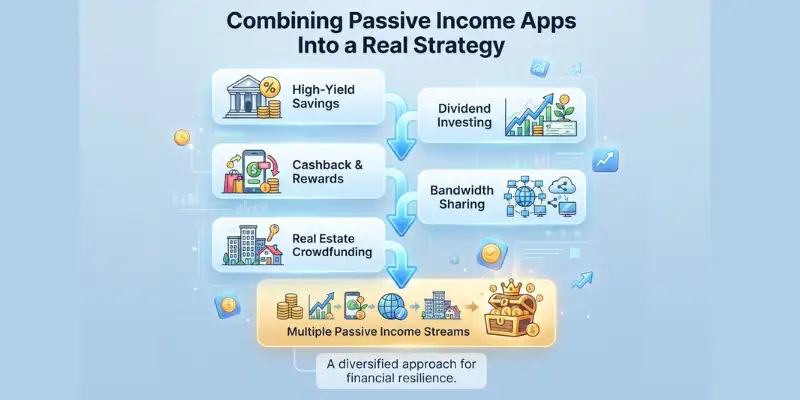
Individual passive income apps tend to generate small amounts in isolation. The more useful approach is to use several complementary apps simultaneously so that small streams from multiple sources add up to something meaningful.
A practical combination for someone just starting out. People who have also built an income stream from selling digital products and using content to drive traffic often use passive income apps to put the earnings from those products to work immediately rather than letting cash sit idle.
A practical combination for someone just starting out:
Use a high-yield savings app for your emergency fund and any cash you are holding short-term, earning 4 to 5 percent instead of the 0.2 to 0.5 percent a traditional savings account pays.
Use a brokerage investment app to build a dividend stock portfolio over time, reinvesting dividends automatically until the portfolio is large enough to provide meaningful quarterly cash.
Use Rakuten for online purchases you were already making, capturing automatic cashback with no behavior change.
Run Honeygain or EarnApp in the background on a device with unlimited broadband, collecting the small but genuinely passive bandwidth income monthly.
Use Arrived or Fundrise to begin building real estate passive income in small amounts, even $100 to $500, that can grow as the portfolio is added to over time.
This combination produces overlapping passive income from five separate sources. None is large individually. Together, they represent a real, functioning passive income system built almost entirely through apps.
People who are also building broader side income alongside passive income often find that these apps work best as the lowest-maintenance layer of a larger income strategy, handling the background income while active efforts go toward building something with higher earnings potential.
The people who get the most out of passive income apps are often the ones who would never describe themselves as investors. Busy professionals, healthcare workers, parents managing demanding schedules: the story of a nurse who built meaningful income quietly alongside a full-time job reflects exactly the kind of person these apps are most useful for. Women building income that fits around existing commitments often find the investment and high-yield savings apps particularly well-suited, since they require the least ongoing time of any option in this category. The broader range of income options women are building on their own terms increasingly includes these app-based passive streams as one low-maintenance piece of a larger picture.
How to Get Started With Passive Income Apps Today
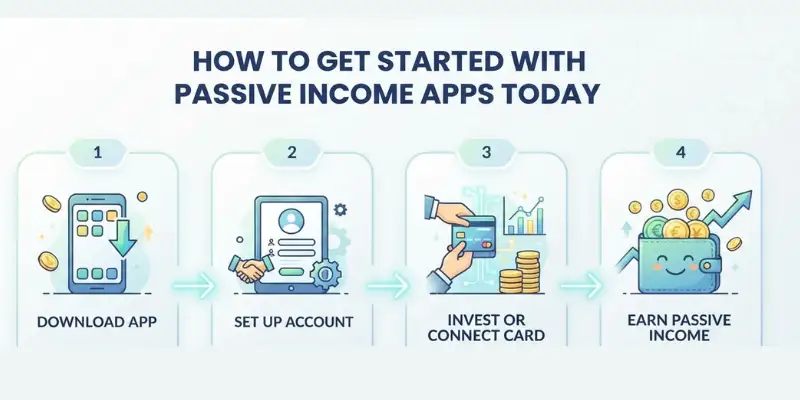
The starting point is simpler than most people expect. Choose one app from each category above that matches your current situation.
If you have savings sitting in a low-interest account, download a high-yield savings app this week and move that money. You will start earning more from day one.
If you have money to invest, open a brokerage app and purchase one dividend ETF. Enable automatic dividend reinvestment and let it compound.
If you have unlimited broadband and a device you leave running anyway, install one bandwidth-sharing app and let it run quietly in the background.
The same principle that applies to starting any income-building project applies to passive income apps: pick one thing, start it this week, and add more once the first one is working. The principle behind building income that works without constant attention is to start small, use what you already have, and add more streams as your familiarity and resources grow. Passive income apps are the most accessible starting point for exactly that approach, even if the amounts start small.
Conclusion: Passive Income Apps Are Real, Just Not Rich
The passive income apps that actually work are not going to make you wealthy on their own. They are going to put a few dollars to a few hundred dollars per month into your account while you do other things. That is genuinely valuable, but it is not the same as the income replacement some promotional content implies.
Investment apps generate the most meaningful passive income over time, particularly as the portfolio grows and dividend reinvestment compounds. High-yield savings apps are the fastest way to improve what existing money earns. Bandwidth sharing apps contribute small but genuinely passive amounts. Cashback apps return real money on spending you were doing anyway.
One thing worth keeping in mind as these apps begin paying out: all of this income is taxable. Understanding how passive income gets taxed before your first interest or dividend payment arrives saves real surprises at filing time. Used together, and combined with more substantial examples of passive income built outside apps, these tools form a useful background layer of income that adds up meaningfully over months and years, even if no individual app alone feels like a meaningful contribution.
Start with what you already have. Add streams gradually. Do not expect transformation. Expect incremental progress that compounds quietly over time.
Frequently Asked Questions About Passive Income Apps
What is a passive income app?
A passive income app is a mobile or desktop application that helps generate money with little ongoing effort after the initial setup. Examples include dividend investing apps, cashback apps, bandwidth-sharing apps, and real estate investing platforms.
Which passive income apps actually pay?
Trusted investment apps such as Fidelity, Vanguard, and Robinhood pay dividends and interest. High-yield savings apps from Marcus, Ally, and SoFi pay competitive interest, while apps like Honeygain, EarnApp, Rakuten, Fundrise, and Arrived also provide verified earnings through their respective services.
How much can you earn from passive income apps?
Earnings depend on the app and your investment or usage. High-yield savings, dividend investing, cashback rewards, and bandwidth sharing can collectively generate anywhere from $50 to $200 per month for many users.
Are passive income apps safe?
Many are safe when offered by regulated financial institutions or well-established companies. Always verify that investment accounts have SIPC protection, bank accounts are FDIC insured, and research any app before installing or investing.
What is the best passive income app for beginners?
High-yield savings apps from Marcus, Ally, or SoFi are excellent starting points because they require no investing experience. Beginners interested in investing can also consider trusted platforms like Fidelity or Vanguard.
Do bandwidth-sharing apps actually pay?
Yes, reputable apps like Honeygain and EarnApp do pay users for sharing unused internet bandwidth. However, earnings are generally modest, typically ranging from a few dollars to around $15 per month.
Can I use multiple passive income apps at once?
Yes. Combining investment, cashback, savings, and bandwidth-sharing apps is a smart way to diversify your passive income and increase your overall monthly earnings.
What passive income apps should I avoid?
Avoid survey apps marketed as passive income, apps promising guaranteed high returns, and platforms without transparent business models or verified payout histories. Always research reviews and company credibility before signing up.

1 Comment
Your insightful blog posts categorize a wide range of topics, always balancing detail and simplicity. It would be intriguing to watch you examine how these ideas might reshape various dimensions, such as transportation or education. Your knack for illuminating intricate subjects is commendable. Thank you for offering such cogent insights—I’m excited to read your next piece!
cruzenews.com