

Search for online passive income and you will find hundreds of nearly identical lists. Twenty-three ideas here, thirty-nine ideas there, all repeating the same handful of suggestions with slightly different wording. Most of these lists were written by people who have never actually tried the things they are recommending.
This article takes a different approach. Instead of listing every possible idea, it focuses on the online passive income methods that genuinely work, explains honestly what they require upfront, and tells you what kind of timeline to expect before money actually shows up. Some popular ideas get left out entirely because they simply do not hold up once you look closely at the math.
The truth about online passive income is this: almost nothing is passive from day one. Every method on this list requires real work, money, or both, before it produces income. What makes it passive is what happens after that initial investment. The income continues without a proportional amount of ongoing effort. That distinction matters, and keeping it in mind will save you from a lot of disappointment.
Table of Contents
What Online Passive Income Actually Means
Online passive income is money earned through internet-based assets or systems that continue generating revenue without requiring active, hour-for-hour work after the initial setup. The range of specific income types that qualify is wider than most people realize, and the online versions of those income types tend to have lower startup costs and higher scalability than their offline counterparts. The internet makes this kind of income more accessible than it has ever been because the cost of reaching an audience, hosting a product, or running a system has dropped dramatically.
But online passive income is not effortless income. A blog that earns $2,000 per month did not appear from nothing. It came from months or years of writing. A digital product that sells while you sleep was created during real hours of focused work. An online course generating monthly enrollments took dozens of hours to record and structure.
The honest framing is this: online passive income trades concentrated upfront effort for distributed ongoing reward. You do the hard part once. The income then arrives in smaller, repeated amounts without you repeating the hard part every time. That shift from trading time for money toward income that keeps arriving without constant effort is what makes this category worth pursuing even when the early timeline feels slow.

Online Passive Income Methods That Actually Work
Creating and Selling Digital Products
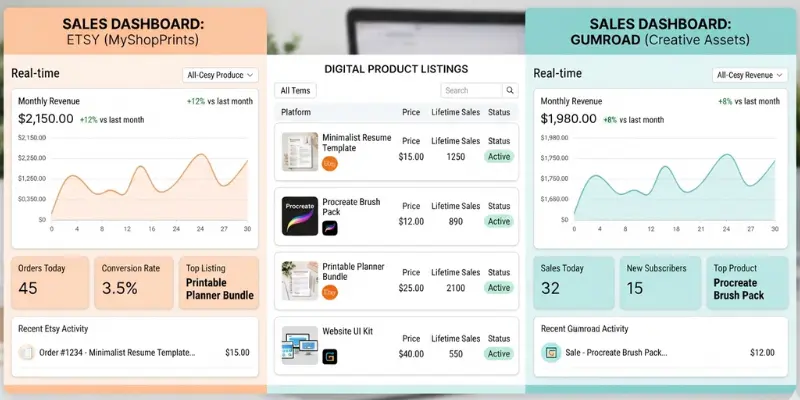
This is one of the most genuinely passive online income methods available, and one of the few that consistently delivers on its promise. You create something once, a template, a planner, a spreadsheet, a design asset, and list it on a platform like Etsy, Gumroad, or Creative Market. Every sale after that requires no additional work from you.
The upfront effort is real but modest. A well-made digital product takes anywhere from two hours to two days to create, depending on complexity. Once it is listed and optimized with the right keywords and a clear description, it can sell repeatedly without you touching it again.
Realistic numbers: new sellers typically earn $0 to $50 per month in their first few months while their listing gains visibility. Established sellers with a catalog of 20 or more well-reviewed products report $500 to $3,000 per month from digital downloads alone. The income scales with the number of products you have listed, since each listing is its own small, independent income stream.
The combination of making digital products and using content to drive traffic to them has become one of the more reliable systems for turning a single product idea into a real income stream, precisely because the content keeps working long after it is published.
Dividend Stock Investing
Owning shares in dividend-paying companies is genuinely passive from the day you buy them. The company pays you a portion of its profits on a regular schedule, typically quarterly, with no action required from you beyond holding the shares.
The honest caveat here is that this method requires capital. You need money to invest before the income arrives, unlike content-based methods where time substitutes for money. A portfolio of dividend stocks for passive income yielding around 4 percent generates $400 per year for every $10,000 invested. That is real, predictable, and requires essentially zero ongoing management once the portfolio is assembled.
This method is best suited to people who already have some savings to deploy or who can commit to consistent monthly investing over a number of years to build the portfolio gradually.
Building a Niche Blog
A focused blog, on one specific topic rather than everything, can generate passive income from advertising, affiliate links, and product sales for years after individual posts are published. The key word is focused. Blogs that cover one specific subject deeply tend to rank better in search results and build a more engaged, returning audience than blogs that cover everything loosely.
The honest timeline matters here. Most bloggers earn nothing for the first three to six months. Meaningful income, in the range of $200 to $500 per month, typically takes 8 to 14 months of consistent posting. The blogs that eventually generate $1,000 to $5,000 per month in largely passive income usually took 18 to 24 months to reach that level.
The reward for the long timeline is that a blogging side hustle keeps earning from content written years earlier. A post written in your first month can still be generating traffic and income two years later, with zero additional work required to maintain it.

Online Courses
Recording a course once and selling it repeatedly on platforms like Teachable, Udemy, or Thinkific is one of the higher-ceiling online passive income methods, though it is also one of the more demanding to set up properly.
The honest reality, confirmed by people who have built genuinely passive courses, is that most courses fail to generate ongoing sales because creators stop at the recording stage and never build a system to keep selling it after the initial launch. A course only becomes passive income when paired with an evergreen funnel, meaning automated emails, a landing page, and a way for new people to discover it continuously without you manually promoting it every week.
Courses that achieve this can generate $500 to $5,000 per month long after the initial creation work is done. Courses that lack this system tend to earn well during a launch and then drop close to zero afterward, which technically is not passive income at all since it requires a new active launch to generate the next wave of sales.
Affiliate Marketing Through Content
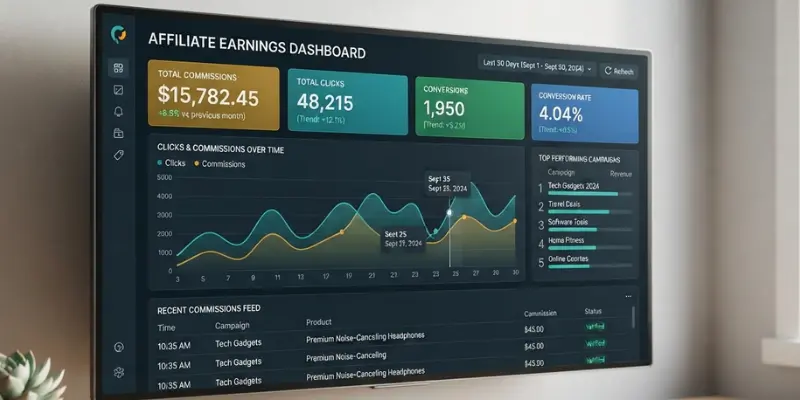
Recommending products through trackable links and earning a commission when people buy is a genuinely scalable online passive income method, but only when attached to content that continues attracting visitors over time. A single review post that ranks well in Google can generate commissions for years without any further work.
The honest catch is that affiliate marketing without traffic earns nothing. The income is entirely dependent on people finding your content, which means this method is really a downstream benefit of blogging, YouTube, or another content platform rather than a standalone strategy. Treat it as a layer added on top of content you are already building rather than a method on its own.
Commission rates vary widely. Amazon Associates pays 1 to 10 percent. Software and financial product affiliates often pay $50 to $200 per referral. A well-ranked piece of content recommending the right product in a high-intent niche can produce meaningful ongoing income with essentially no maintenance.
Renting Out Digital or Physical Assets Through Online Platforms
Platforms like Turo for cars, Neighbor for storage, and Airbnb for spare rooms let you earn passive income from assets you already own, with the platform handling discovery, booking, and payment. This is one of the most natural entry points into building real estate passive income without buying a new property, since it uses what you already have rather than requiring significant new capital. Your role shifts from active management to occasional oversight.
This is genuinely one of the lower-effort entries on this list because it does not require creating anything new. You are monetizing something that already exists in your life. A parking space, a spare bedroom, a car you do not use every day, all become income sources through the right platform.
The honest limitation is that this method requires you to already own the asset, and the income scales with what you have available to offer rather than with effort or creativity, which puts a natural ceiling on how far it can grow without acquiring additional assets.
Online Passive Income Methods That Get Overhyped
Being honest about what does not work as well as advertised is just as important as covering what does.
Print on demand stores with no marketing plan. Listing products on Etsy or Shopify without any plan to drive traffic to them rarely produces meaningful income. The platform does not send buyers automatically. Without content, ads, or some form of audience building, a print on demand store sits quietly with no sales.
Faceless YouTube channels using only AI-generated content. Channels that rely entirely on automated, low-effort content tend to plateau quickly. YouTube’s algorithm increasingly favors content that demonstrates genuine value and engagement, and audiences notice when content feels hollow. The channels that succeed in this category usually involve real editorial judgment behind the automation, not full automation alone.
Crypto trading bots promising guaranteed returns. Automated trading platforms that promise consistent passive income from cryptocurrency markets carry real risk that gets glossed over in promotional content. Markets move unpredictably, and any tool claiming guaranteed profit deserves serious skepticism. This is closer to speculation than passive income.
Surveys and microtask apps. These pay so little per task, often pennies, that the realistic hourly rate falls well below minimum wage in most countries. They are not passive income. They are extremely low-paying active work disguised as something more.
How AI Tools Have Changed the Online Passive Income Landscape
One real shift in recent years is how artificial intelligence tools have compressed the time it takes to build online passive income assets. The specific AI tools that help most are the ones that accelerate content creation and product design rather than the ones that promise to generate income automatically with no human involvement. Writing, design, and even video production that used to take weeks can now take days. This has lowered the barrier to entry significantly for content-based passive income methods.
The honest nuance here is that AI tools accelerate the creation of assets. They do not replace the need for a real strategy, real distribution, or real value behind what you create. A blog post written faster with AI assistance still needs to rank in search results and actually help the reader, or it will not generate income no matter how quickly it was produced.
Used correctly, AI tools speed up the slowest part of building online passive income, the initial creation phase, without changing the fundamental requirement that what you create needs to be genuinely useful to someone searching for it.

What a Realistic Online Passive Income Timeline Looks Like
Being honest about the timeline is the single most useful thing this article can offer, because most competing content either skips this entirely or wildly understates it.
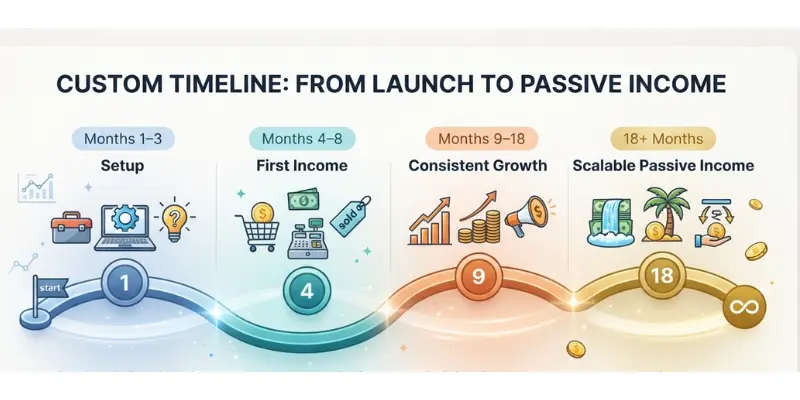
One thing worth knowing before any of these income streams start paying is that all online passive income is taxable. The passive income tax rules vary depending on the source, and understanding them before your first payment arrives prevents surprises at filing time. Months one through three: This is almost entirely set up. You are creating products, writing content, or assembling an investment portfolio. Income during this period is typically $0 to $100 across most methods.
Months four through eight: Early traction appears. Digital products start getting occasional sales. Blog posts start ranking for low-competition keywords. Dividend portfolios, if funded consistently, start paying noticeable quarterly amounts. Income in this range typically runs $100 to $500 per month.
Months nine through eighteen: This is where genuinely passive income starts to feel real. Content has had time to accumulate search rankings. Product catalogs have grown. Investment portfolios have compounded. Income in the $500 to $2,000 per month range becomes realistic for people who stayed consistent through the slower early months.
Beyond eighteen months: For people who kept building rather than stopping at the first plateau, online passive income streams can reach $2,000 to $10,000 per month or more, particularly when multiple methods are combined and reinforcing each other.
This timeline is longer than most promotional content admits. But it is the honest version, and understanding it upfront is what separates people who quit too early from people who actually reach meaningful income.
How to Choose the Right Online Passive Income Method for You
The right starting point depends on what you have more of right now: time or money.
If you have more time than money, content-based methods, blogging, digital products, and affiliate marketing, let you build income with minimal financial investment. The cost is mostly your hours.
If you have more money than time, dividend investing and renting out assets you already own require less ongoing time but more upfront capital.
If you want a method that produces some income relatively quickly, renting an existing asset or starting a focused digital product line tends to show results faster than blogging or course creation, which take longer to build an audience.
Some of the more compelling online passive income stories come from people in demanding full-time careers who built something meaningful on the side. The story of a nurse who quietly built real income alongside a demanding job shows how this approach works in practice across very different professions. Women building income that fits around existing commitments often find digital products and dividend investing particularly well-suited, since both can be built incrementally without requiring a fixed daily schedule.
Students with more available time than capital are well-positioned for low-cost online income options that build over the course of their studies, particularly content creation and digital products, both of which compound the longer they are maintained.
RELATED POSTS
Getting Started With Online Passive Income Today
The biggest barrier to building online passive income is not lack of ideas. This article alone covers several solid options. The barrier is starting one of them and sticking with it through the slow early months when the income has not yet appeared.
Pick one method from this list. Commit to it for a minimum of six months before judging whether it is working. Most of the discouragement people feel with online passive income comes from quitting in month two, right when the early invisible groundwork is being laid for what shows up in month eight.
The first step in building income that works outside your regular job is rarely complicated. It is just specific. Choose your method, take the first concrete action this week, and give the system the time it actually needs to start paying you back.
Conclusion: Online Passive Income Is Real, But It Is Not Instant
Most people start with income they earn through direct active work and build online passive income streams alongside it, using what they earn actively to fund what eventually earns passively. The honest version of online passive income is less exciting than most headlines suggest, but it is far more useful. It is real. People genuinely build it, every day, through digital products, dividend investing, blogging, online courses, and smart use of existing assets. None of it happens overnight, and none of it is free of upfront effort.
What makes online passive income worth pursuing is not the promise of effortless money. It is the promise of income that eventually detaches from your hours, built through real work that compounds over time rather than disappearing the moment you stop showing up.
Start with one method. Be patient with the early months. And trust that the people who succeed at online passive income are not the ones who found a secret. They are the ones who kept going after the results were slow.
Faqs
What is online passive income?
Online passive income is money earned through internet-based assets, products, or investments that continue generating revenue without requiring active, ongoing work after the initial setup. Common examples include digital product sales, dividend stocks, blog advertising, and affiliate marketing.
Is online passive income actually passive?
Not at the beginning. Most online passive income methods require significant upfront effort, time, or money. Once the foundation is built, they can continue generating income with much less ongoing work.
How much can you realistically earn from online passive income?
Earnings vary by method and consistency. Many beginners earn $0–$100 per month during the first few months. After 8–14 months, $200–$500 per month is realistic, while established income streams can exceed $1,000–$5,000 per month.
What is the fastest way to start earning online passive income?
Renting out an existing asset, such as a spare room or car, is usually the fastest option. Selling digital products on platforms like Etsy or Gumroad can also generate income within a few weeks if the listing is well optimized.
Do you need money to start building online passive income?
Not always. Blogging, affiliate marketing, and digital products require very little money but significant time. Dividend investing and rental income generally require more upfront capital.
How long does it take to see real results from online passive income?
Most methods take between 6 and 12 months to generate consistent income. Content-based strategies, such as blogging, often require 12–18 months before producing reliable monthly earnings.
Are AI tools useful for building online passive income?
Yes. AI tools can speed up writing, designing, and content creation, helping you build passive income assets more efficiently. However, they cannot replace a solid strategy, quality content, or long-term consistency.
What online passive income methods should I avoid?
Be cautious of print-on-demand stores without a marketing strategy, fully automated AI content sites, crypto trading bots promising guaranteed profits, and survey or microtask apps. These often deliver poor results or involve unnecessary risk.

2 Comments
Pingback: What Is Passive Loss? Rules, Limits & Examples
Pingback: Nurse Side Hustles: 15 Ideas For RNs, LPNs And NPs